UK Greyhound Predictions: Form Analysis & Betting Guide
A structured approach to reading form, assessing trap draws, interpreting going conditions, and identifying value in UK greyhound racing markets.
 Available in US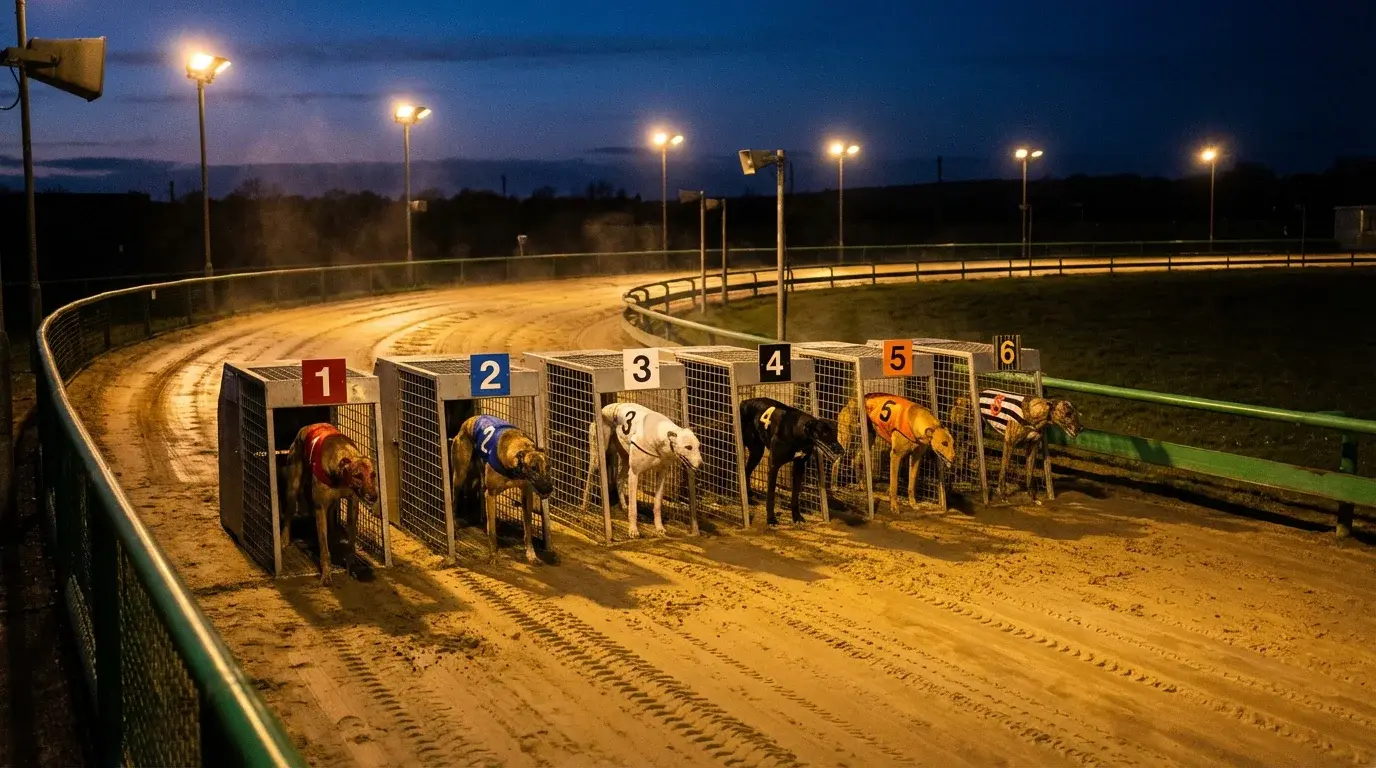
What Makes Greyhound Predictions Different from Backing a Favourite
Backing the favourite in UK greyhound racing returns roughly one win in three — and that's before you factor in margin. According to OLBG data from 2024, the favourite in graded racing won 35.67% of the time across all GBGB-licensed tracks. That sounds respectable until you run the maths on starting prices. A dog sent off at even money needs to win 50% of its races just to break even. At 35%, you're bleeding money slowly, steadily, and with all the confidence of someone who thinks the shortest price always means the best dog.
Key Fact
In 2024, the average favourite win rate across all UK graded greyhound races was 35.67%. At individual tracks, it ranged from 31.60% at Kinsley to 42% at The Valley. In open races, where favourites tend to be shorter-priced, the rate climbed as high as 52% at Central Park.
This guide is not about telling you which dog to back tonight. It is about equipping you with the analytical framework that separates prediction from guesswork. Greyhound racing, more than almost any other betting medium, rewards method. Six runners, a mechanical hare, and a sand track — the variables are finite, the data is accessible, and the margins between dogs are often measured in hundredths of a second. That makes it a sport where homework genuinely pays.
Over the following sections, you will learn to read form like a professional, assess trap draws with statistical context, interpret going conditions, match your predictions to the right bet types, and manage your bankroll with discipline rather than hope. Whether you are new to the dogs or a seasoned punter looking to sharpen an existing method, the principles here are the same: gather data, analyse it honestly, and bet only when the evidence supports your position. Everything else is entertainment.
How Greyhound Predictions Actually Work
A prediction is a thesis — assembled from data, not from a hunch at the betting shop counter. The difference between a tipster who strikes at 40% over a thousand selections and one who strikes at 25% is almost never about insider knowledge or supernatural instinct. It is about process. The stronger predictor follows a repeatable pipeline: collect data, analyse form, assess the draw, factor in conditions, watch race replays, and only then arrive at a selection. The weaker one skips most of those steps and calls it experience.
The pipeline starts with the race card. Every GBGB meeting publishes a card that contains recent form figures, best times, trap allocations, trainer details, weight, and race grade. This is raw material, not a conclusion. The card tells you what has happened; your job is to determine what it means for what will happen next. A dog showing form figures of 111231 looks impressive, but those wins might have come in a lower grade, on a different track surface, or against weaker opposition. Context is everything.
From form, the analysis moves to the trap draw. In a six-runner field, starting position is not neutral — it dictates the path each dog takes to the first bend, and the first bend frequently decides the race. After the draw comes a check on going conditions: is the track running fast, normal, or slow? Has it rained? Is a headwind blowing into the back straight? These are not decorative details. They reshape the competitive order.
Sectional time — the time recorded for a specific segment of a race, typically the run to the first bend and the closing section from the final bend to the line. Sectional times reveal whether a dog leads early and fades or finishes strongly from behind.
The final layer, often overlooked, is visual. Watching race replays — available free through SIS feeds and bookmaker streams — shows what the numbers cannot: how a dog behaves at the boxes, whether it was hampered at the first bend, and whether a disappointing finishing position concealed a strong run. A dog that finished fourth after being squeezed out at the bend is a very different proposition from one that led for 400 metres and stopped. The form figure is the same. The story is not.
Systematic prediction does not guarantee winners. It guarantees that your selections are based on evidence rather than emotion. Over time, that distinction is the difference between a punter who grinds a profit and one who funds the bookmaker's margin.
Understanding the pipeline is one thing. Applying it to an actual race card is another — and that is where form analysis earns its keep.
Form Analysis Essentials for UK Greyhound Racing
The race card tells a story — but only if you can read the language. Form analysis is the single most important skill in greyhound prediction, and it is the step most casual punters either skip or skim. They glance at the last finishing position, note that trap 1 won its previous race, and move on. That is not analysis. That is pattern recognition without context, and it is roughly as useful as picking horses by name.
Proper form analysis means examining a dog's last five or six runs with attention to grade, track, distance, time, trap drawn, going conditions, and the narrative of the race. Each variable modifies the meaning of raw form figures. A dog that finished third at A2 grade around Nottingham over 500 metres is not the same proposition as one that finished third at A8 around Kinsley over 462 metres. Grade, circumference, and distance change the frame of reference, and ignoring them is the fastest way to misjudge a race.
Reading the Race Card Line by Line
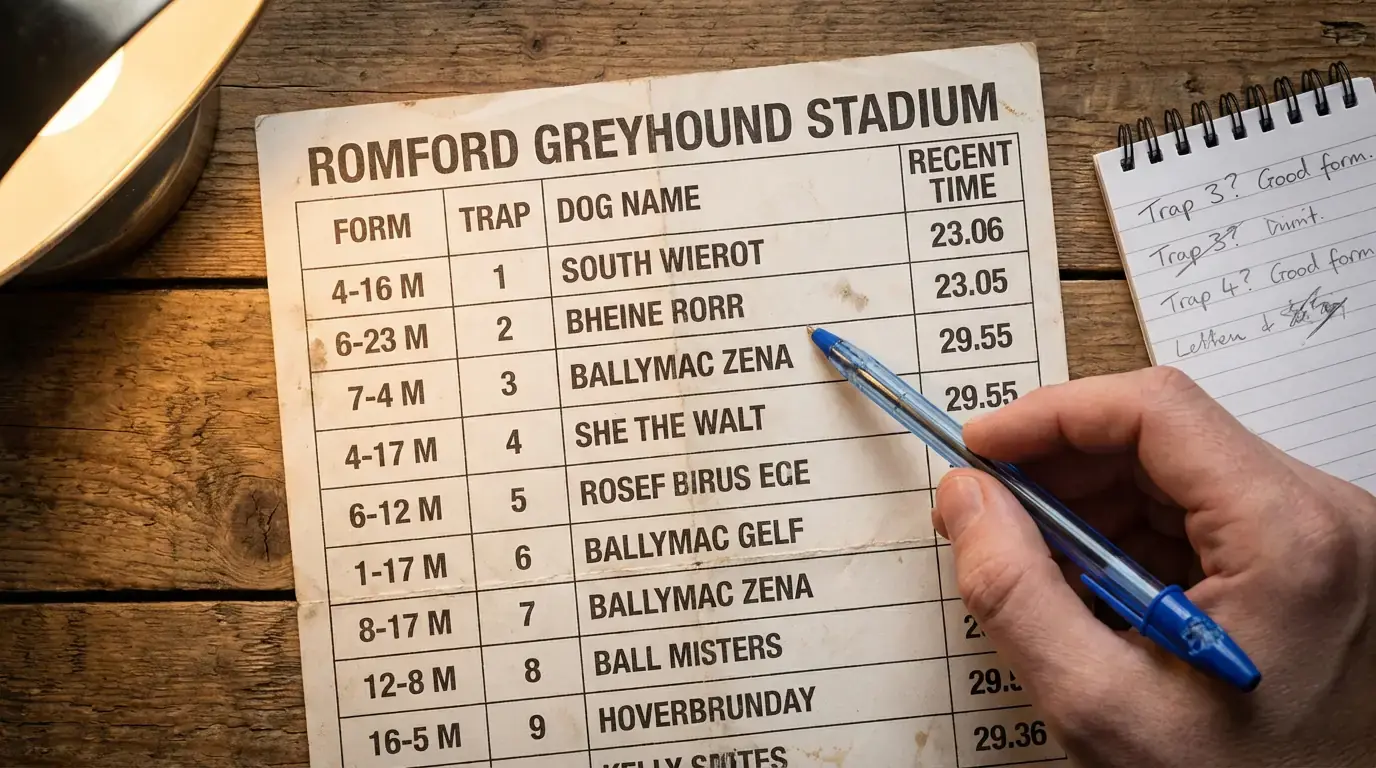
A standard UK greyhound race card displays, for each runner: trap number, dog name, form figures (the finishing positions from recent races), trainer name, weight at last weigh-in, best time at the track and distance, a comments line from the racing manager, and the race grade. Some cards also show sectional times, sire and dam, and the number of days since the dog's last run.
Form figures are sequences of numbers representing finishing positions. A line reading 231141 tells you the dog's last six races ended in second, third, first, first, fourth, first — read left to right from oldest to most recent. Letters appear too: "m" indicates a mid-division finish without a specific placing being relevant to the form context, while a dash means the dog did not race or the run was void. The critical thing is not the sequence itself but the direction. Is the form improving? Declining? Consistent? A dog showing 665321 is trending sharply upward. One showing 112346 is heading the other way, and backing it at a short price because it won two starts ago is a classic trap.
The trainer line matters more than many punters realise. UK greyhound trainers vary enormously in strike rate, and certain kennels dominate at specific tracks. A trainer who regularly campaigns dogs at Romford will understand that track's characteristics — its tight bends, its bias towards early-pace dogs — far better than one sending a runner there for the first time. Checking kennel form over the last month is a two-minute task that can save you from backing a dog whose connections are out of form.
What Sectional Times Reveal About Running Style
Best times and recent times are the bread and butter of time analysis, but sectional times are where genuine edge lives. A sectional split divides the race into two phases: the run from boxes to the first bend (or to the halfway point, depending on the track) and the closing section from there to the line. Two dogs might both clock 29.50 over 480 metres, but if one runs 4.10 to the bend and closes in 25.40, while the other runs 3.85 and closes in 25.65, their profiles are entirely different. The first is a closer who finishes strongly from mid-pack. The second is a front-runner who leads but fades slightly in the closing stages.
Why does this matter? Because the first-bend position is the single strongest predictor of finishing position in greyhound racing. Dogs that lead at the first bend win far more often than those who trail. If you can identify which dog in a six-runner field is most likely to reach the bend first — using a combination of trap draw, early pace from sectional data, and box speed — you have the foundation of a solid prediction.
Class Drops, Class Rises, and What They Signal
The UK grading system runs from A1 (the highest standard for graded races) down to A11, with open races (OR, OR1, OR2, OR3) sitting above the graded structure and invitational events at the very top. Dogs move between grades based on performance: a dog that wins repeatedly at A5 will be raised to A4 or A3, while one that finishes in the lower half consistently will be dropped. The GBGB amended its Rules of Racing from January 2026, including updated requirements on racecourse homing and injury retirement policies — but the grading mechanics that matter to punters remain unchanged. These movements are signals, and reading them correctly is essential.
A class drop is not always good news. Yes, the dog is now racing against weaker opposition, but it was dropped for a reason — perhaps its times have slowed, it suffered an injury, or it has lost confidence at the boxes. The smart play is to check why the drop occurred. If the dog was competitive at the higher grade but unlucky — hampered at the first bend repeatedly, drawn on the wrong side — then a class drop gives it a genuine advantage. If it was simply outclassed, the drop only softens the level of defeat.
Class rises work in reverse. A dog stepping up from A6 to A4 is facing faster, more tactical opponents. But if it romped home in its last two A6 races by six lengths, the grader had no choice. Watch whether the step-up time is competitive for the new grade. If it is, you may have found a dog whose recent form understates its true ability.
The Trap Draw: Why Starting Position Shapes Every Race
Experts say the three most important things in greyhound racing are draw, draw, and draw. That is only a slight exaggeration. In a six-trap system, where every runner breaks from a stationary position and converges on the first bend within three or four seconds, the starting position determines running lines, dictates crowding risk, and often settles the race before the back straight even begins.
UK greyhound racing uses traps numbered 1 to 6, with trap 1 on the inside rail and trap 6 on the outside. Graders allocate traps based on a dog's known running style: railers — dogs that prefer to hug the inside rail — are placed in traps 1 and 2. Middle runners, comfortable in either direction, go into traps 3 and 4. Wide runners, those that naturally drift towards the outside or prefer a clear run around the field, are assigned traps 5 and 6. This is not random. It is designed to reduce interference, though it does not always succeed.
The trap draw creates inherent advantages and disadvantages that vary by track. A tight-turning track like Romford, with its 350-metre circumference, punishes wide runners disproportionately because the bends are sharp and the inside line is dramatically shorter. At a larger circuit like Towcester, with its 420-metre circumference and sweeping turns, the outside draw is far less punishing. Understanding your track's geometry is the first step in using trap statistics productively.
Railer — Traps 1-2
Shortest path to the first bend. Thrives on tracks with tight turns. Vulnerable if slow out of the boxes, as mid-pack crowding can push them off the rail. Best in sprint races where early position is decisive.
Middle Runner — Traps 3-4
Flexibility to go either side depending on pace. Statistical edge at many UK tracks — trap 3 often records the highest overall win rate. Can exploit gaps left by railers and wide runners. Suits tactical dogs with moderate early pace.
Wide Runner — Traps 5-6
Cleaner run to the first bend with less traffic. Covers more ground on the bends, so needs superior stamina or speed to compensate. Best at larger circuits where the extra distance is marginal. Strong in middle-distance races where closing speed matters.
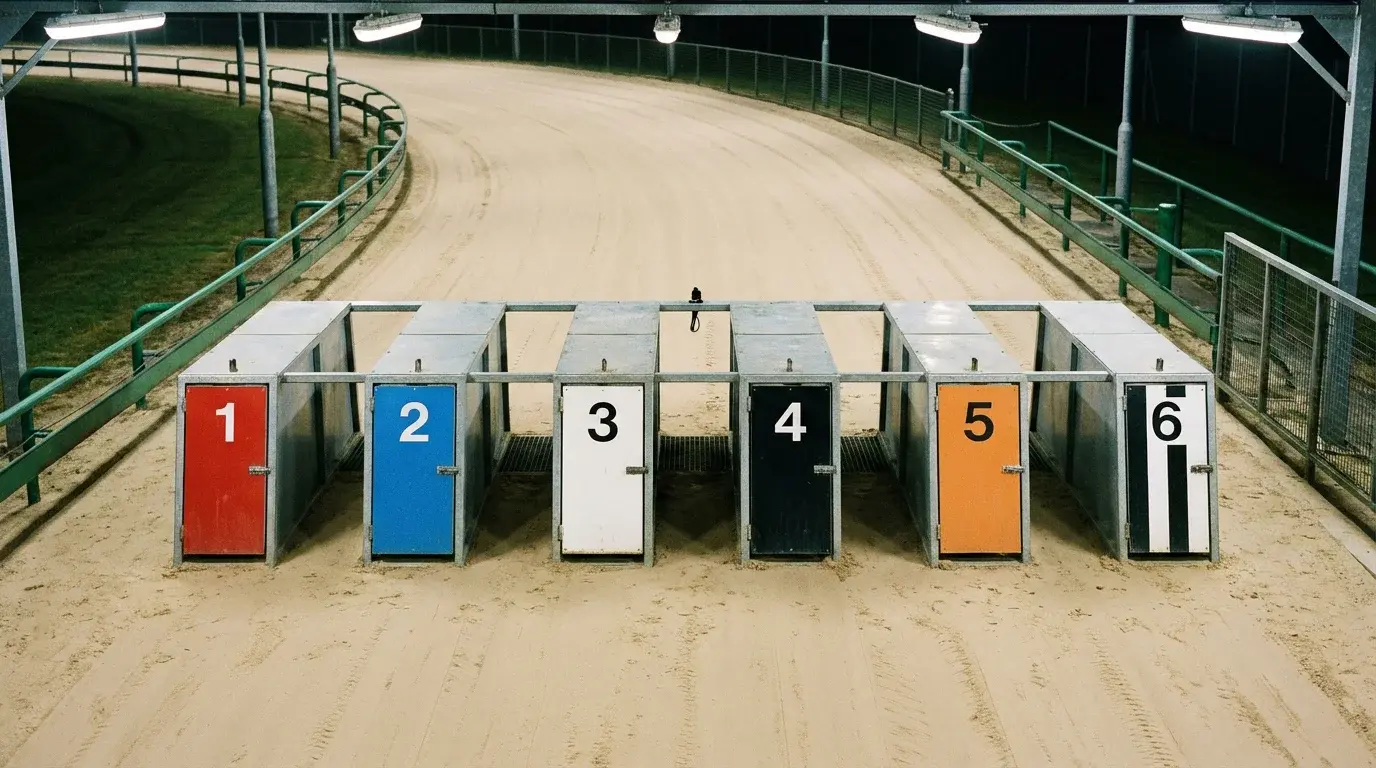
Aggregate statistics show trap 3 producing the highest win percentage across UK tracks, typically around 18-19% of all wins, compared to roughly 15-16% for traps 1 and 6. But these averages conceal significant track-to-track variation. At some venues, trap 1 dominates because the first bend is close to the boxes and the rail is king. At others, trap 6 benefits from a wide-running bias on the opening bend. The only way to use trap data properly is to study it track by track, distance by distance — and to update your knowledge regularly, because track surfaces change, box positions shift, and biases evolve.
When two dogs in a race look equally matched on form and time, give the edge to the one drawn in the statistically stronger trap for that specific track and distance. It is not a dramatic advantage, but in a sport where margins are tiny, a two-percentage-point trap bias is often the difference between a winning selection and a near miss.
Going Conditions and Track Surface: The Hidden Variable
Sand, rain, and a headwind — three words that can rewrite an entire card. Going conditions are the variable that many punters acknowledge in theory and ignore in practice. They check the form, assess the draw, even watch a replay — and then completely forget to ask whether tonight's track surface bears any resemblance to the surface on which that form was recorded.
Every GBGB-licensed track in the United Kingdom runs on sand. The standard going descriptions are fast, normal (sometimes called "standard"), slow, and wet, and they are determined by track staff before each meeting based on weather, watering, and surface maintenance. The difference between fast going and slow going at the same track and distance can be four to six lengths — which, in timing terms, translates to roughly 0.30 to 0.50 seconds over a standard 480-metre trip. That gap is enormous in a sport where the entire field can be separated by a second.
UK greyhound tracks were originally grass. Sand became the standard surface because maintaining turf through English winters proved too costly and too unreliable — waterlogged turf meant cancelled meetings, and the commercial model could not absorb the lost revenue.
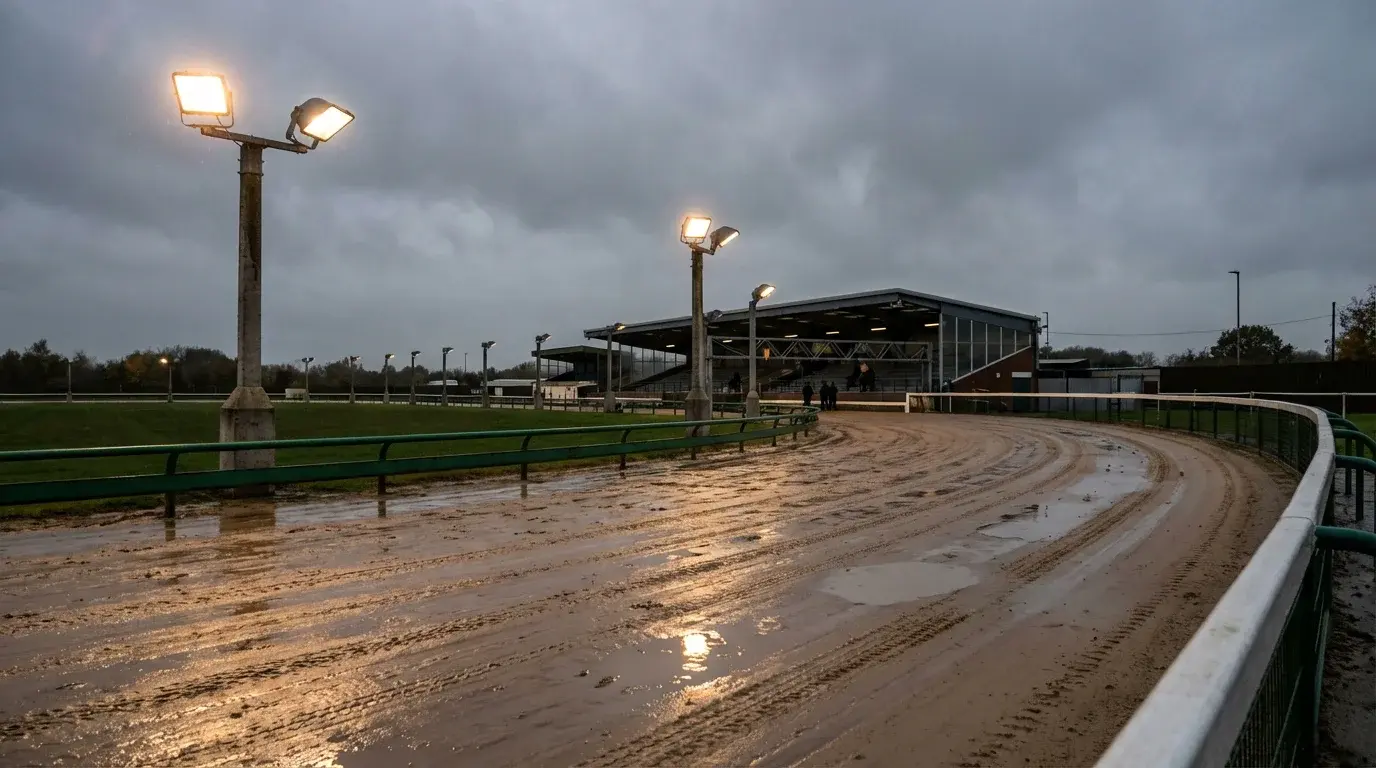
How do conditions affect different types of dog? Heavy, powerful dogs with a muscular frame tend to handle wet or slow going better than lighter, more angular runners. Their weight gives them traction on a surface that saps speed from lighter dogs. Conversely, on fast going, a light, leggy dog with explosive early pace can gain lengths out of the traps that a heavier dog simply cannot match. This is not theoretical. Watch any meeting held on a rain-soaked evening and count how many short-priced favourites are undone by going they are not built for.
The practical step is simple: when you analyse a dog's recent times, always note the going. A 29.40 on fast going is not the same as 29.40 on slow going — the latter is significantly more impressive. Some experienced analysts apply rough adjustments: add 0.30 to 0.40 seconds to a fast-going time to normalise it, or subtract the same from a slow-going time. These are approximations, not science, but they prevent you from making the most common time-comparison error in greyhound betting.
Running Styles and How to Exploit Them in Your Picks
Every greyhound has a preference — your job is to find the race where that preference becomes an advantage. Running style is not a fixed label applied once and forgotten. It is a behavioural pattern that interacts with trap draw, pace dynamics, and track geometry to determine how a race unfolds. Understanding styles is what turns a decent form reader into someone who can genuinely map a race before the traps open.
There are three broad categories of running style in UK greyhound racing. Railers hug the inside rail from the first bend onwards, covering the shortest possible distance and relying on an unobstructed path along the fence. Middle runners show no strong bias towards either side and are often tactical, moving to whichever gap appears at the bend. Wide runners swing to the outside, either by preference or because their trap position pushes them there, and they compensate for the extra ground by carrying superior speed through the bends.
The distinction matters because of pace maps. Before every race, a serious predictor should ask: who leads at the first bend? If two early-pace dogs are drawn in adjacent traps, they will likely crowd each other, and neither may get a clean run. If a confirmed front-runner is drawn in trap 1 with no other fast starter inside it, the race is set up for that dog to lead uncontested — which, as sectional data consistently shows, dramatically increases its chance of winning. Pace mapping does not require software. It requires reading the sectional times for each runner and overlaying them onto the trap draw to see who crosses the first bend in front.
| Railer | Wide Runner |
|---|---|
| Strengths: Covers minimum distance. Strongest when leading or in clear second on the rail. Excels at tight-turning tracks. | Strengths: Avoids first-bend traffic. Strong closing speed. Excels at larger circuits where bends are sweeping. |
| Weaknesses: Vulnerable to crowding on the rail. If beaten for position at the first bend, can be trapped behind slower dogs with no room to overtake. | Weaknesses: Covers more ground on every bend. Needs to be significantly faster to compensate. Tight tracks neutralise their advantage. |
| Ideal conditions: Traps 1-2, tight circuits, fast going that rewards early speed, sprint distances. | Ideal conditions: Traps 5-6, larger circuits, middle-distance or staying trips where stamina offsets the extra ground. |
| Key trap positions: 1, 2. Occasionally 3 if the dog has sharp early pace and can cut across to the rail. | Key trap positions: 5, 6. Sometimes 4 if drawn alongside a confirmed railer in 5 who will move left. |
The exploit comes when style and circumstance align. A railer drawn in trap 1, with fast early pace and no other front-runner inside traps 2 or 3, has a clear path to the first bend. That is an edge you can quantify. Equally, a wide runner drawn in trap 6 at a large track with slow-going conditions — which sap the advantage of front-runners — is set up to close from behind. Recognising these patterns is what elevates a prediction from plausible to confident.
Choosing the Right Bet Type for Your Prediction
A strong prediction deserves the right bet — not every pick is a win single. One of the most common errors in greyhound betting is treating all selections identically. You identify a dog you fancy, back it to win, and either collect or don't. But the strength of your conviction, the nature of the race, and the odds available should all influence which bet type you choose. A confident top pick in a weak field is a different proposition from a value selection in a competitive open race, and the bet should reflect that.
The simplest bet is a win single: your dog finishes first, you collect. This is the right choice when your analysis gives you a strong favourite in a race where the opposition looks beatable. Win bets are clean, easy to track, and force discipline — you either got it right or you didn't. For most punters building a long-term record, win singles should be the default.
An each-way bet splits your stake into two: half on the win, half on the dog to place (typically first or second in a six-runner field, at one-quarter of the win odds). Each-way makes sense when you are confident a dog will be competitive but less certain it will win — perhaps it is stepping up in grade, or drawn in an awkward trap, but its form says it should be thereabouts. The place half provides a safety net that a win single does not.
A forecast requires you to predict the first and second finishers. A straight forecast means exact order; a reverse forecast covers both permutations (your two selections in either order, for double the stake). Forecasts suit races where you have a strong view on two dogs but the win is too tight to call. The Computer Straight Forecast (CSF) calculates the payout based on starting prices, and returns can be substantial — a 3/1 and 5/1 finishing first and second can easily return ten to fifteen times your stake.
A tricast predicts first, second, and third in exact order. Combination tricasts cover all six permutations of your three selections, at six times the unit stake. There are 120 possible finishing orders for the first three in a six-runner field, so the maths is against you — but when form narrows the likely frame to three dogs, a combination tricast can produce outsized returns from a modest outlay.
BET EXAMPLE
Dog A — Trap 3 — Win at 7/2
Stake: £10 win
Return if wins: £45.00 (£35 profit + £10 stake)
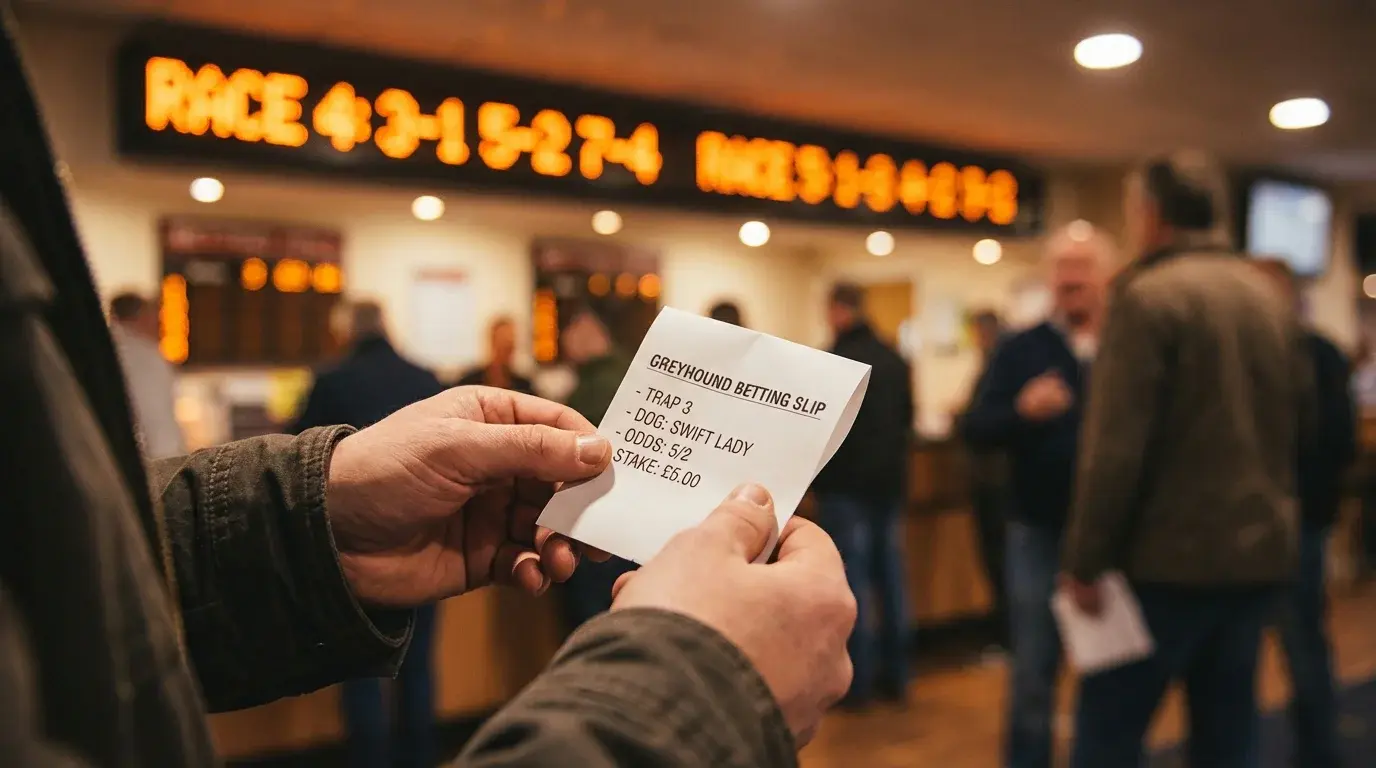
Dog A — Trap 3 — Each-way at 7/2 (1/4 odds a place, 1-2)
Stake: £10 E/W (£5 win + £5 place)
If wins: £22.50 (win) + £9.38 (place) = £31.88
If finishes second: £9.38 (place return only)
Beyond these core types, UK greyhound betting offers trap challenge bets (which trap produces the most winners across a meeting) and jackpot or accumulator bets across multiple races. These are high-variance products. Fun, occasionally lucrative, but not the foundation of a serious strategy. Use them when you fancy a flutter, not when you are trying to build a profitable record.
The guiding principle is straightforward: match your bet type to the strength of your opinion. Strong conviction, single dog, clear edge — win single. Good conviction, two dogs in the frame — forecast. Moderate conviction, solid dog in a competitive race — each-way. Treat the bet type as the final decision in the prediction process, not an afterthought.
Work out who reaches the first bend in front
Sectional times laid over the trap draw and each dog's running line, so you can see the lead before the traps open — and see which dogs are going to be in each other's way when they get there.
Staking Plans and Bankroll Discipline
Staking plans don't create winners — they keep winners solvent. You can have the sharpest form analysis in the country, but if your staking is erratic, you will lose money. That is not an opinion. It is arithmetic. A punter who bets £50 on Monday's confident selection and then chases Tuesday's losses with £200 on a dog they haven't analysed is not betting — they are gambling emotionally. The distinction matters.
The simplest and most effective staking method is level stakes. You bet the same amount on every selection, regardless of odds, confidence, or how your last bet went. If your bankroll is £500 and you stake 2% per bet, that is £10 on every selection. Win or lose, the next bet is £10. Level stakes are boring. They are also the method used by almost every professional punter and tipster who publishes verified results, because they make it impossible to inflate a record by increasing stakes on winners and hiding losses on big bets.
Percentage staking is a variation where your stake is a fixed percentage of your current bankroll. As your bankroll grows, so do your stakes; as it shrinks, they decrease automatically. This protects against ruin more aggressively than flat level stakes, because your bets get smaller during losing runs. The downside is that recovery from a drawdown takes longer, since your reduced bankroll generates smaller stakes. For most punters, 1-3% of bankroll per bet is a sensible range.
What you should avoid — emphatically — is any form of recovery staking. The Martingale system, where you double your stake after every loss to recoup previous losses with a single win, is mathematically destructive in greyhound markets. It looks appealing on paper, but it ignores a fundamental reality: losing streaks of eight, ten, even twelve consecutive bets are not unusual when you are backing dogs at 3/1 to 5/1. In a six-runner field, even a dog with a 30% win rate will produce regular losing runs of that length.
Warning
Recovery staking systems escalate quickly in six-runner fields. A losing streak of eight to ten is not unusual and can exhaust a bankroll in a single session. If you start with a £10 stake and double after every loss, your ninth bet is £2,560 — to recover a cumulative loss of £2,550. One more loss and you are over £5,000 down from a £10 starting point. No edge survives that kind of leverage.
Bankroll discipline also means record-keeping. Track every bet: date, track, race, selection, trap, odds, stake, result, return. A spreadsheet takes five minutes to set up and thirty seconds per bet to update. Without records, you are guessing at your own performance. With them, you can calculate strike rate, return on investment, and — critically — identify which types of race, track, or bet type produce your best results. The data you collect about yourself is often more valuable than the data you collect about the dogs.
Set a loss limit per session and per week. If you hit it, stop. Continuing after a limit is breached means your decisions are no longer governed by analysis — they are governed by frustration. And frustration is the most expensive emotion in betting.
Spotting Value: When the Odds Are Wrong in Your Favour
Value isn't about the winner — it's about the price. This is the single hardest concept for recreational punters to internalise, because it runs counter to every instinct. You back a dog at 4/1. It loses. Was it a bad bet? Not necessarily. If your analysis showed that dog had a 30% chance of winning, and the odds implied only a 20% chance, you found value. The fact that it lost does not retrospectively change the quality of the bet. It only changes how you feel about it — and feelings are not a staking plan.
Value exists when the probability you assign to an outcome is higher than the probability implied by the odds. To calculate implied probability from fractional odds, use a simple formula: if the odds are 4/1, the implied probability is 1 / (4 + 1) = 20%. If you believe the dog wins 30% of the time, the gap between 30% and 20% is your edge. Bet at that price often enough, and the edge accumulates into profit. Bet at fair prices — where your probability matches the market's — and you slowly lose to the bookmaker's margin.
Estimating your own probability is where the work lies. There is no shortcut here. You need to have analysed the form, assessed the draw, factored in conditions, and arrived at a view before you look at the price. If you check the odds first, you anchor your analysis to the market's opinion, and the entire exercise collapses. The order matters: analyse first, then compare your assessment to the available price. If the price is bigger than your assessment suggests it should be, you have a value bet. If it is shorter, you pass.
Two practical tools help. First, best odds guaranteed (BOG) — offered by most major UK bookmakers on greyhound racing. If you take an early price of 5/1 and the starting price drifts to 7/1, BOG ensures you are paid at the better price. This is free expected value. Second, exchange odds on Betfair or Smarkets often differ from bookmaker odds because exchanges operate with lower margins. Comparing bookmaker and exchange prices before every bet takes thirty seconds and can add meaningful percentage points to your long-term return.
If a dog wins 30% of the time and the odds imply 20%, every bet at that price carries value — regardless of individual race outcomes.
The hardest part of value betting is patience. You will have losing days, losing weeks, and stretches where it feels like the approach is broken. It is not. Variance in greyhound racing is high — six-runner fields, short races, and frequent interference mean that even strong-value selections lose more often than they win. The edge only materialises over hundreds of bets, not dozens. If you cannot commit to that timescale, value betting will frustrate you. If you can, it is the most reliable path to long-term profitability that greyhound racing offers.
Five Prediction Mistakes That Cost Punters Money
Most punters don't lose because they pick bad dogs — they lose because they bet badly. The errors below are not obscure analytical failures. They are everyday habits that bleed bankrolls dry, and almost every greyhound bettor has been guilty of at least three of them at some point. Recognising them is step one. Eliminating them is what separates a serious predictor from someone who just enjoys the rush.
Ignoring the trap draw. You find a dog with outstanding recent form — two wins and a second from its last three runs. You back it. What you did not notice is that those runs came from trap 1 at Monmore, and tonight the dog is drawn in trap 6 at Romford. Its entire running style is built on hugging the rail from a low draw. In a wide trap at a tight-turning track, that form is almost meaningless. The trap draw is not supplementary information. It is foundational. Every prediction should start with the draw and work outwards, not the other way around.
Chasing short-priced favourites. Favourites win about a third of the time. At average starting prices of around 6/4 to 2/1, that strike rate does not produce a profit. Backing every favourite is a slow way to lose, and backing favourites without analysis is even worse, because you are deferring your judgement to the market — a market that includes casual money, promotional offers, and punters who back the top name without reading the card. Short prices need short-price logic: is the dog so clearly superior that the field cannot compete? If you cannot answer that with evidence, the price is not justified.
Neglecting going conditions. A dog clocks 29.20 on fast going and you conclude it is a flyer. That time is not transferable to slow going without adjustment. Ignoring the going is the time-analysis equivalent of comparing house prices without knowing whether you are looking at London or Lincolnshire. The number means nothing without context. Check the going for every historical run you use in your analysis, and apply rough adjustments before comparing times across different nights.
Emotional attachment to a dog. You backed a dog three times. It won twice and paid well. You now consider it "your" dog and back it every time it runs, regardless of draw, grade, or conditions. This is loyalty, not analysis. Dogs are athletes with variable form, and they do not know your name. The moment you stop evaluating a dog objectively because you have a history of backing it, you are no longer predicting — you are hoping. And hope is not a strategy.
Overcomplicating with accumulators. Accumulators — backing multiple selections across different races with rolling returns — offer enormous headline payouts. They also lose at a staggering rate. A four-fold accumulator where each leg has a 40% chance of winning produces a combined probability of roughly 2.5%. You lose 97.5% of the time. Accumulators are entertainment products dressed up as serious bets. Treat them accordingly.
Tools and Resources for Smarter Predictions
You don't need proprietary software — you need the right free resources and the patience to use them. The greyhound betting market is unusually generous with data. Unlike horse racing, where sectional timing is a relatively recent innovation, greyhound racing has published trap stats, form figures, and running times for decades. The challenge is not access — it is knowing where to look and what to do with what you find.
Racing Post remains the starting point for most serious form students. Its greyhound section provides race cards, results, form figures, trainer statistics, and track-by-track data. The digital edition offers searchable form and replays for recent meetings. For anyone building a prediction method from scratch, this is the primary reference.

Timeform applies its own rating system to greyhound racing, offering a numerical assessment of each dog's ability alongside form commentary. Timeform ratings are particularly useful for comparing dogs across different tracks and grades, because the rating adjusts for the quality of opposition. A Timeform rating of 95 at one track is supposed to mean the same as 95 at another — something that raw times cannot guarantee.
RPGTV and SIS provide live and archived race coverage. RPGTV broadcasts meetings with commentary and analysis, while SIS (Satellite Information Services) supplies the live feeds that appear in bookmaker shops and on streaming platforms. Watching replays through these services lets you see what the form figures hide: trouble in running, bumping, slow starts, and the visual markers of a dog that ran better than its finishing position suggests.
Greyhound-Data.com is an independent database tracking individual dogs across their careers — breeding, race history, trial results, and lineage. It is useful for assessing dogs debuting at a new track and provides trap statistics broken down by track and distance, essential for the draw analysis discussed earlier.
Betfair Exchange serves a dual purpose. It is a betting platform with lower margins than traditional bookmakers, and it is a market-information tool. Watching how exchange prices move in the minutes before a race tells you where the money is going. A dog that shortens sharply on the exchange is attracting informed money — not proof of a winner, but a data point worth noting alongside your own analysis. In 2026, with 18 GBGB-licensed tracks racing almost daily, the volume of data available to anyone with an internet connection and a basic spreadsheet is extraordinary. The edge is not in having better tools than the next punter. It is in using the same tools more consistently and more honestly.
Frequently Asked Questions
How do you read a greyhound race card to find the best prediction?
A UK greyhound race card displays each runner's trap number, recent form figures (finishing positions from the last six runs), trainer, weight, best time at the track and distance, and race grade. Start by reading the form sequence to identify whether a dog's results are improving or declining. Then compare best times, adjusting for going conditions — a fast-going time of 29.30 is not equivalent to 29.30 on slow going. Check the trap draw against the dog's known running style: a railer drawn wide, or a wide runner on a tight track, faces a structural disadvantage. Finally, note the grade. A dog dropping in class may have an edge on raw ability, but only if the class drop was not caused by declining form. The race card is the starting point, not the answer — it provides the data from which you build a prediction.
Do favourites win often enough to be profitable in UK greyhound racing?
In 2024, favourites in UK graded greyhound races won approximately 35.67% of the time across all GBGB tracks. That figure sounds healthy, but profitability depends on the average price, not the strike rate alone. Favourites typically start at around 6/4 to 2/1, and at those odds a 35% win rate does not generate a long-term profit after bookmaker margins. Blindly backing every favourite is a slow losing strategy. However, selectively backing favourites where your form analysis supports the market's assessment — and the price offers fair value — can be profitable. The key is selectivity: not every favourite is equal, and the 35% average conceals wide variation by track, grade, and race conditions.
What factors matter most when predicting greyhound race outcomes?
The most influential factors are trap draw, recent form, sectional times, going conditions, and running style. The trap draw determines each dog's path to the first bend — the most decisive moment in most greyhound races. Recent form reveals current ability, while sectional times show whether a dog leads early or finishes strongly. Going conditions alter the competitive order: heavy dogs handle wet surfaces better, while light dogs excel on fast going. Running style, combined with the trap draw, tells you whether a dog's natural preference aligns with the race setup. No single factor is sufficient on its own. The strongest predictions come from layering all five into a coherent assessment and then comparing that assessment to the available odds to determine whether there is value.
The Real Edge Is Patience, Not a System
There is no secret formula at the track — only a handful of people willing to do the work the rest won't. If you have read this far, you have already demonstrated something that separates you from the majority of greyhound punters: the willingness to learn before you bet. That is not a small thing. The betting industry is designed to reward impulsiveness, and every flashing odds board and "bet now" prompt is engineered to compress the gap between seeing a race and staking money on it. Slowing down is, in itself, an edge.
The methods in this guide — form analysis, trap draw assessment, going condition adjustments, sectional time reading, value identification — are not complicated. None of them require specialist software, paid subscriptions, or mathematical expertise beyond basic percentages. What they require is consistency. Doing the analysis for one meeting is easy. Doing it for fifty, a hundred, two hundred meetings without cutting corners is what separates the punters who grind a small profit from those who lose slowly and blame luck.
The GBGB's 2026 racing calendar features 50 category one competitions and 27 category two events spread across the country, marking the centenary of greyhound racing in the United Kingdom. From the Greyhound Derby at Towcester in late spring to the winter derbies at Monmore and open events at the newly opened Dunstall Park, there is no shortage of racing to apply these principles to. The sport is very much alive, and so is the opportunity for anyone willing to approach it with discipline.
Here is your practical next step: pick one track. It might be your local venue or the one whose cards you find most accessible online. Study it for a month. Learn its trap biases, its going patterns, its regular trainers. Build a spreadsheet. Record every prediction and every result. After thirty days, you will know more about that track than 90% of the people betting on it — and you will have the data to prove whether your method works or needs adjusting.
Greyhound prediction is not about finding the perfect system. It is about building a process you trust, testing it against reality, and having the patience to let the results accumulate. The dogs will keep running. The question is whether you will keep learning.
