 Available in US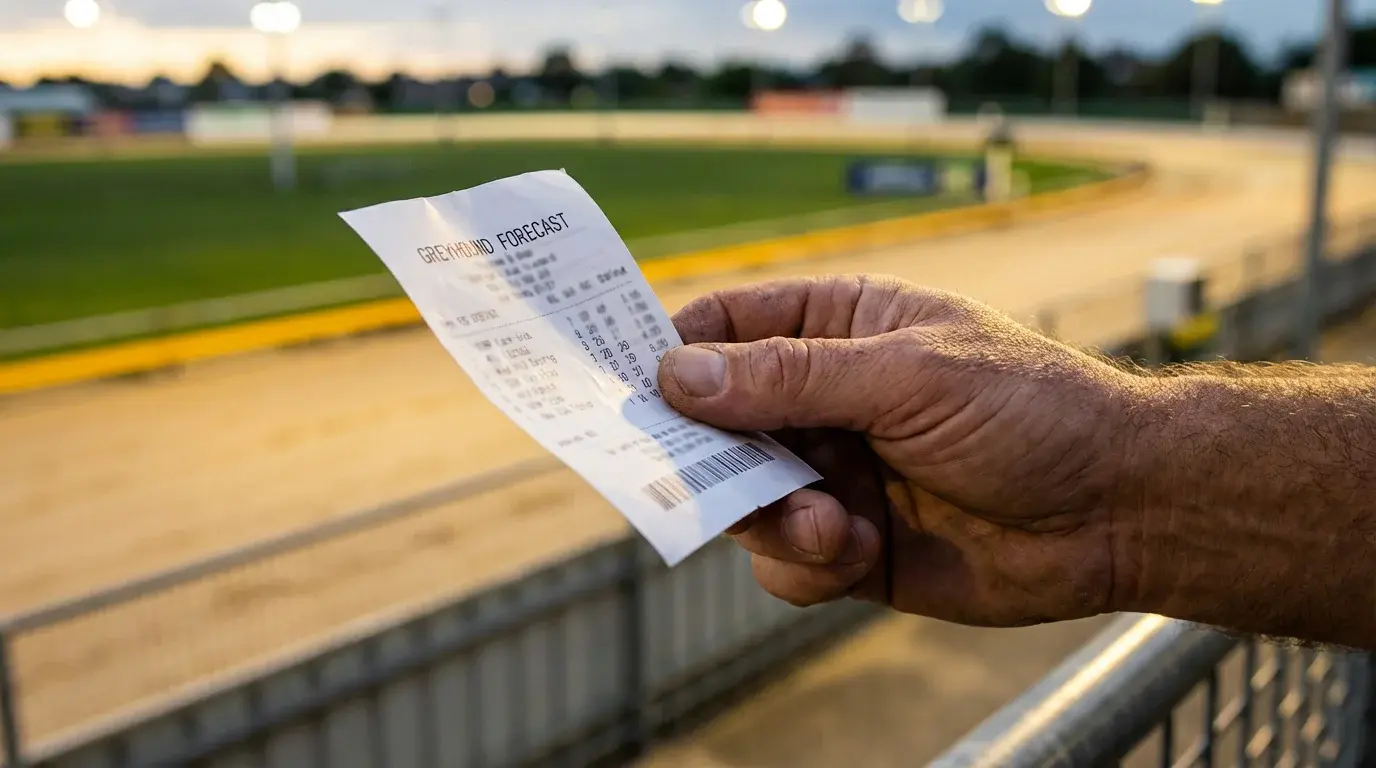
Six Dogs, Dozens of Markets — Know What You’re Betting On
There are more ways to bet on a six-dog race than most punters ever realise. Walk into any betting shop or open any online bookmaker during a greyhound meeting, and you’ll find a menu that stretches well beyond picking the winner. Win singles, place bets, each-way, forecasts, tricasts, trap challenges, jackpots, Tote pools, exchange markets — the options are broad enough to suit every level of confidence and every size of bankroll.
Most punters stick to win singles. There’s nothing wrong with that — a win bet is the purest expression of a prediction. But restricting yourself to one bet type means you’re using the same tool for every situation, regardless of whether it’s the right fit. A race where you’re confident about the winner but not the exact finishing order calls for a different approach than one where you can separate the top two but can’t pick between them. A race with a vulnerable favourite demands a different bet type entirely.
This guide covers every major bet type available in UK greyhound racing — from the straightforward to the exotic, from the bookmaker to the exchange. For each, we’ll explain the mechanics, the mathematics, and the situations where it makes strategic sense. The goal is to give you a complete toolkit, so that every prediction you make is paired with the bet type that extracts the most value from it.
Because getting the analysis right is only half the job. The other half is knowing what to do with it.
Win and Place Bets: The Foundation
Win bets are confidence. Place bets are insurance. Each-way is both. Before you explore anything more complex, these two bet types need to be completely understood, because everything else builds on them.
A win bet is the simplest wager in greyhound racing: you pick a dog, and if it finishes first, you collect. The return is calculated by multiplying your stake by the odds. A £10 win bet at 5/1 returns £60 — your £10 stake plus £50 profit. If the dog finishes second or lower, you lose your stake entirely. Win bets are appropriate when your analysis points clearly to one runner and you have high confidence in the selection. They’re also the most transparent way to track your betting performance, because the result is binary — right or wrong.
A place bet requires your selection to finish in the top two in a standard six-runner greyhound race. The trade-off is that place odds are lower — typically a quarter of the win odds, though terms vary between bookmakers. A dog offered at 8/1 for the win would pay roughly 2/1 for the place. Place bets suit situations where you believe a dog will be competitive but aren’t confident enough to back it for the outright win. They’re also useful for higher-priced selections where even a place finish generates a reasonable return.
The distinction between win and place betting shapes how you assess every race. If your form analysis identifies a strong favourite that you expect to win but the odds offer poor value (say, 4/6), a win bet may not be worth the risk relative to the return. But if you identify a 6/1 shot that you believe has a genuine chance of finishing in the top two, a place bet at around evens might offer a better risk-to-reward ratio. Understanding when to step down from a win bet to a place bet — or up from a place bet to a win bet — is a fundamental skill that many punters never develop.
Each-Way Betting in Greyhound Racing
Each-way betting transforms a near-miss into a return — if the terms are right. An each-way bet is effectively two bets in one: a win bet and a place bet on the same dog, at the same stake. If you place a £5 each-way bet, you’re staking £10 in total — £5 on the win and £5 on the place.
In greyhound racing, the standard each-way terms are one-quarter of the win odds for a top-two finish. So if you back a dog each-way at 8/1 with a £5 unit stake, the win part pays £45 (8 x £5 + £5 stake) if the dog wins, and the place part pays £15 (2/1 x £5 + £5 stake). If the dog wins, you collect both — a total return of £60 on a £10 outlay. If the dog finishes second, you lose the win part (–£5) but collect the place part (+£15), for a net return of £10 — you break even. If the dog finishes third or worse, you lose the full £10.
Each-way betting is most valuable at longer odds. On a short-priced favourite at 2/1, the each-way place return at 1/2 barely covers the combined stake if the dog only places. But on a 10/1 outsider, the place component alone at 5/2 delivers a meaningful profit even without the win. This is why experienced punters tend to use each-way selectively — backing longer-priced dogs they believe are being underestimated by the market, where even a place finish generates a positive outcome.
One trap to watch: some bookmakers offer reduced each-way terms for greyhound racing, paying one-fifth rather than one-quarter of the odds. Always check the terms before placing, because the difference significantly affects the value of the place component. A dog at 8/1 paying one-fifth for a place returns just £1.60 profit on a £1 place stake, compared to £2.00 at one-quarter terms. Over hundreds of bets, that gap compounds.
Forecast Bets: Predicting First and Second
A forecast bet asks for precision — and it pays accordingly. Instead of picking just the winner, a forecast requires you to predict which dog finishes first and which finishes second. Get both right, in the correct order, and the payout is substantially larger than a simple win bet. Get either one wrong — or get the order reversed — and you lose.
There are two main types. A straight forecast requires you to name the first and second finishers in exact order. Dog A first, Dog B second. This is the harder bet to land but offers the highest reward. A reverse forecast covers both possible orders — Dog A first and Dog B second, or Dog B first and Dog A second. A reverse forecast costs twice the stake (because it’s two bets), but it removes the burden of predicting the exact order.
Most UK bookmakers calculate forecast returns using the Computer Straight Forecast (CSF) formula rather than offering fixed odds. The CSF is determined after the race, based on the starting prices of all runners and the actual finishing order. This means you won’t know your exact return before the race — unlike a fixed-odds win bet. CSF dividends vary widely depending on the prices of the first two finishers. A 2/1 favourite beating a 3/1 second favourite might return a CSF of £12–£15 for a £1 stake. A 10/1 outsider beating another outsider can return £100 or more.
The appeal of forecasts lies in the enhanced returns for a relatively modest increase in analytical difficulty. If your form analysis is strong enough to identify the likely winner, extending that analysis to the second dog adds a layer of reward without requiring a fundamentally different skill set. You’re already assessing the entire field — the forecast simply asks you to rank the top two rather than just the top one.
The risk is that forecasts are harder to land than win bets, by definition. In a six-runner field, there are 30 possible first-and-second combinations. Random chance gives you a 1-in-30 shot on a straight forecast (3.3%), compared to 1-in-6 (16.7%) on a win bet. Your form analysis needs to be meaningfully better than random to make forecasts profitable over time. For most punters, forecasts work best as occasional plays in races where the form clearly points to two dogs, rather than as a default bet type.
When Forecast Bets Offer the Best Value
Not every race suits a forecast. The ideal profile is one with a clear form pick for first place and a strong but less obvious candidate for second — typically a closer or an improver that the market undervalues. When the favourite is a genuine standout and you can identify a second dog that’s been overlooked because of an unfashionable draw or a misleading recent result, the CSF dividend often exceeds what you’d get from a win single on the favourite alone.
Races with a dominant favourite priced at even money or shorter are prime forecast territory. The win bet on such a favourite returns very little relative to the risk. But pairing that favourite with a 6/1 or 8/1 second selection in a straight forecast can triple or quadruple the return. You’re leveraging your confidence in the favourite by combining it with a view on the supporting cast.
Avoid forecasts in wide-open races where four or five dogs have a genuine chance. The combinatorial explosion works against you — too many plausible outcomes dilute your edge. Forecasts reward conviction about the top two, and if you don’t have that conviction, a different bet type is the smarter choice.
Tricast Bets: First, Second, and Third in Order
Tricasts are the lottery of greyhound betting — except form analysis tilts the odds. A tricast requires you to predict the first three finishers in exact order. In a six-runner field, there are 120 possible permutations for the top three, making a straight tricast a roughly 1-in-120 proposition on random chance alone. The returns reflect this difficulty — tricast dividends regularly reach three figures and occasionally four figures for a £1 stake.
Like forecasts, most bookmakers settle tricasts using a computer-calculated formula based on starting prices. The Computer Tricast dividend can be enormous when outsiders fill the places. A 12/1 shot winning from two other long-priced dogs can produce returns of £500 or more on a single pound. But the variance is extreme: you can go dozens of races without landing one.
A combination tricast softens the difficulty by covering all six possible orders of your three selected dogs. This costs six times the unit stake (since it’s six separate straight tricasts) but removes the need to predict the exact sequence. If your three dogs finish in the top three in any order, you collect. The trade-off is the higher outlay — a £1 combination tricast costs £6 — and the fact that the dividend is for the specific finishing order, which may not be the most lucrative combination of your three selections.
The “banker plus two” approach is a popular tricast strategy. You identify one dog as your banker — the most likely winner — and pair it with two selections for second and third. You then take a combination tricast on the three, covering all orders, or a straight tricast with your banker in first and the other two in either order (two bets). This approach concentrates your confidence where it’s strongest and spreads the uncertainty across the less predictable positions.
Tricasts should be treated as high-variance plays with occasional big returns, not as a regular betting method. If you’re staking significant amounts on tricasts every race, the cumulative outlay will almost certainly exceed the returns. The smart approach is to reserve them for races where three dogs separate clearly from the field on form — competitive enough to produce an uncertain finish among those three, but with a clear quality gap between them and the rest.
Trap Challenge, Jackpot, and Exotic Bets
Exotic bets are entertainment first, investment second. They offer the thrill of outsized returns for small stakes, but the probability of winning is correspondingly low. If you enjoy them for what they are — a flutter with a dream attached — they add fun to a race night. If you treat them as a serious betting strategy, they’ll drain your bankroll.
A trap challenge asks you to select which trap number will produce the most winners across an entire meeting — typically 10 to 12 races. You pick trap 1 through 6, and the one with the most wins by the end of the card takes the prize. The appeal is simplicity, but the outcome is essentially random across a small sample. Trap 1 might have a slight statistical edge nationally, but over a single evening of 12 races, any trap can come out on top. The payouts are pooled, which means the dividend depends on how many other punters picked the same trap.
Jackpot bets require you to pick the winner of multiple races — typically six consecutive races at one meeting. The probability of selecting all six winners correctly, even with strong form analysis, is vanishingly small. Six races with six runners each produce 46,656 possible outcomes. Jackpots are funded by a pool, and when nobody hits the full jackpot, a rollover builds the prize fund, occasionally creating eye-catching payouts that make headlines but obscure the underlying odds.
Daily doubles and pick-three bets are smaller-scale versions of the jackpot concept — pick the winner of two or three nominated races. They’re more achievable than a full jackpot and can produce decent returns when you have strong views on specific races within a meeting. Of all the exotic bets, these are the ones most amenable to form analysis, because the combinatorial challenge is manageable.
The sensible rule of thumb: allocate exotic bets their own small budget, separate from your main bankroll. If you enjoy a trap challenge or a jackpot slip, play with money you’ve mentally written off. Keep your serious staking for the bet types where your analysis has a realistic chance of producing consistent returns.
Tote Betting vs Fixed-Odds Betting
The Tote and the bookie price the same race differently — and one will always be better. Understanding the distinction between pool betting and fixed-odds betting gives you an additional angle for maximising returns on every greyhound race you bet.
Fixed-odds betting is what most punters use by default. You accept the odds displayed at the time you place your bet, and those odds determine your return regardless of how the market moves afterwards. If you back a dog at 5/1 and it drifts to 8/1 before the off, your return is still calculated at 5/1. The advantage is certainty — you know exactly what you’ll receive if the dog wins. Many bookmakers also offer best-odds-guaranteed (BOG) on greyhounds, meaning if the starting price is higher than the price you took, you’re paid at the better price.
Tote (pool) betting works differently. Your stake goes into a collective pool with all other bettors on that race. After the track takes its deduction (typically around 15–20%), the remaining pool is divided among winning ticket holders. The dividend isn’t known until after the race, because it depends on the total pool size and how much was staked on the winning dog. When a well-fancied dog wins, the Tote payout is often lower than fixed odds because most of the pool backed that dog. But when an outsider wins, the Tote can pay significantly more than the SP, because fewer punters backed it and the pool is split among fewer tickets.
The practical implication is that checking both prices before betting — even quickly — can add percentage points to your long-term returns. On a short-priced favourite, fixed odds usually offer better value. On a bigger-priced selection, the Tote dividend sometimes exceeds the bookmaker price by a substantial margin. This is particularly true at evening meetings with larger on-course pools, where the Tote dividend is more meaningful. At smaller BAGS meetings with thin pools, the Tote payout can be volatile and is less reliable as a pricing reference.
Betting Exchanges: Back and Lay on Greyhounds
Exchanges let you play both sides of a bet — and for greyhound racing, that changes everything. A betting exchange, with Betfair being the dominant platform in the UK, is a marketplace where punters bet against each other rather than against a bookmaker. This fundamentally alters the economics of greyhound betting.
On an exchange, you can back a dog (betting it will win, just as with a bookmaker) or lay a dog (betting it won’t win). When you lay, you take on the role of the bookmaker for that bet — you accept another punter’s stake, and if the dog wins, you pay out the winnings. If the dog loses, you keep their stake minus the exchange’s commission, which is typically 2–5% on net winnings depending on the platform and your activity level.
The lay option is the most transformative feature for greyhound punters. In a six-runner field, the ability to bet against a dog — essentially backing the other five runners simultaneously — opens strategic options that traditional bookmakers don’t offer. If your analysis tells you a favourite is vulnerable but you can’t identify which of the other five will win, laying the favourite is the logical bet. You don’t need to pick the winner; you just need to be right that a specific dog won’t win.
Exchange odds are typically more competitive than bookmaker odds because there’s no bookmaker margin built into the prices. The overround on an exchange market is usually close to 100%, compared to 115–120% at a traditional bookmaker. This means better prices for backers and more accurate market pricing overall. The trade-off is commission, which reduces your net profit on winning bets — but the improved odds usually more than compensate.
The main limitation for greyhound exchange betting is liquidity. Compared to horse racing or football, greyhound markets are thinner. At major evening meetings, there’s usually enough money in the market to get bets matched at reasonable prices. At lower-profile BAGS meetings, liquidity can be sparse, meaning your bet might not get matched at the price you want — or at all. In-play trading, where you back and then lay (or vice versa) during the race to lock in a profit, is possible on greyhounds but requires fast execution and an understanding of how the market reacts to race dynamics.
The Art of Matching Your Bet to Your Prediction
The bet type is the final piece of the prediction puzzle — choose wrong and even a correct analysis yields nothing. Every prediction carries a confidence level, and every confidence level has a bet type that fits it best. The skill is matching the two.
When your form analysis produces a strong, clear favourite — one dog separates from the field on every metric — the appropriate bet is a win single. Maximum conviction, maximum simplicity. The odds may be short, but if your assessment is right, the win bet converts that assessment into profit with no unnecessary complications.
When you’re confident in a dog’s ability but the win odds don’t justify the risk — typically at prices of even money or below — an each-way bet or a forecast can extract better value. The each-way play gives you a safety net if your selection runs well but doesn’t win. The forecast, combining your top pick with a secondary selection, offers enhanced returns that compensate for the short win price on the favourite.
When two or three dogs are closely matched and you can’t separate them on form, dutching — splitting your stake proportionally across multiple selections — is more honest and more profitable than picking one at random. The dutching approach accepts the uncertainty and structures the bet to profit from any of your shortlisted dogs winning.
When your analysis identifies a vulnerable favourite rather than a confident selection — a dog whose price is shorter than its true probability — laying on the exchange is the bet that fits. You don’t need to know who wins. You just need to be right about who doesn’t.
And when a race is genuinely unreadable — the form contradicts itself, the draw is awkward for every runner, the going is uncertain — the best bet is no bet at all. Passing a race isn’t a failure of analysis; it’s the application of it. The punters who make money long-term are the ones who bet only when their prediction matches a bet type that offers value. Everything else is noise.
Find more betting guides at greyhoundpredictions.
Also read our greyhound betting odds explained.
