 Available in US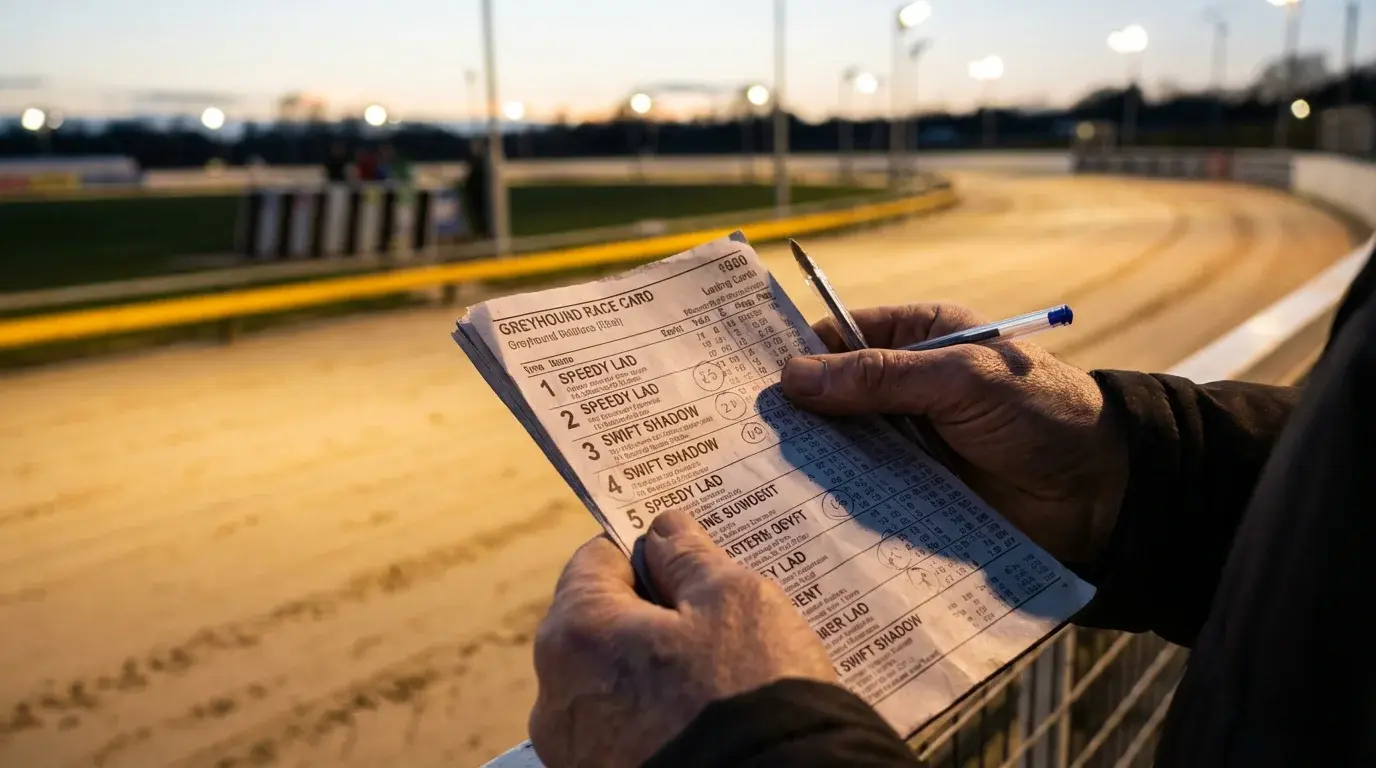
Your First Greyhound Race Card — Decoded
A race card is a cheat sheet — but only if you know where to look. For anyone new to greyhound betting, that dense grid of numbers, abbreviations, and trainer names can feel like reading someone else’s shorthand. It is not. Every element on the card exists to tell you something specific about the dog, its recent history, and its chances tonight.
The good news is that greyhound race cards are simpler than their horse racing equivalents. There are six runners, no jockeys to assess, no complicated handicap weights. A standard UK greyhound card gives you the trap number, the dog’s name, recent form, the trainer, a weight, a best time, and sometimes a brief comment from the racing manager. That is the entire dataset — and once you learn to read it, every race becomes a puzzle you can solve.
This guide walks through the card from left to right, column by column. By the end, you should be able to look at a race card and immediately identify which dog has the best recent form, which is dropping in class, and which is badly drawn. Those three things alone will put you ahead of anyone betting on trap numbers or names they like the sound of.
What Each Column on the Card Means
Start left, read right — each column adds a layer of information. The layout is consistent across every GBGB-registered track in Great Britain, so once you learn the structure at Monmore, it applies identically at Romford, Hove, or Towcester.
Trap number. This appears first, usually colour-coded: trap 1 is red, 2 is blue, 3 is white, 4 is black, 5 is orange, 6 is black and white stripes. These colours are standardised across all GBGB-registered tracks under Rule 118. The trap number determines the dog’s starting position and, crucially, which section of the track it occupies for the first bend. Railers — dogs that prefer running close to the inside rail — are typically seeded into traps 1 and 2. Wide runners go into traps 5 and 6. This is not random. The racing manager assigns traps based on each dog’s preferred running line, which brings us to the next column.
Dog name and running style. After the name, you will often see a letter in brackets: (m) for middle runner, (w) for wide runner. If there is no letter, the dog is classified as a railer. This seeding system determines which trap position each dog is allocated. This single piece of information is surprisingly powerful. A railer drawn in trap 5 is badly drawn — it will need to cross traffic to reach the rail. A wide runner in trap 1 will drift outward and potentially cause interference. Mismatches between running style and trap position are one of the easiest angles for beginners to identify.
Form figures. A sequence of numbers showing the dog’s finishing positions in its most recent races, reading left to right with the most recent run on the far right. A sequence like 2 1 1 3 1 1 tells you the dog has won four of its last six. A sequence full of 5s and 6s suggests the opposite. Dashes indicate the dog did not race. Letters like m or w sometimes appear within form sequences at some providers, but this varies by source.
Trainer. The trainer’s name and sometimes their kennel location. Trainers matter more in greyhound racing than many beginners assume. Some trainers have significantly higher strike rates than others, particularly at their home track. A dog trained by someone with a 25% win rate at Sheffield is a different proposition from one trained by someone hitting 12%. Kennel form — whether a trainer’s dogs are generally running well at the moment — is also worth checking before a meeting.
Weight. Listed in kilograms, usually to one decimal place. The weight itself matters less than the trend. A dog arriving 0.5 kg heavier than its previous three runs might be carrying extra condition. A steady weight over several runs suggests stable condition, which is positive.
Best time. This is the dog’s fastest recorded time at the specific track and distance for the race. It is usually marked with an asterisk. Comparing best times across the six runners gives you a rough speed ranking, but context matters — a best time set on fast going in July is not directly comparable to recent form on slow going in February. More useful is comparing each dog’s recent times to its own best, which tells you how close it is to peak performance right now.
Comment or race note. Some platforms include a short comment from the racing manager or analyst. These notes might say “led until crowded bend two” or “slow away, finished well.” They explain why the finishing position was what it was. A dog that finished fifth after being hampered at the first bend is a very different prospect from one that finished fifth in a clear run.
How to Interpret Form Figures
Form figures are a dog’s racing CV compressed into a handful of digits. They tell you where the dog finished in each recent race, with the most recent result sitting on the right-hand side of the sequence. In UK greyhound racing, where every race features six runners, the numbers range from 1 to 6.
A strong run of form might look like 1 1 2 1 3 1 — mostly wins, with the occasional place finish. That is a dog in excellent form and likely competing at or below its ability level. Compare that with 5 6 4 6 5 6. This dog is consistently finishing at the back of the field. Either it is outclassed at its current grade, carrying an issue, or simply not in form. Either way, it is not a dog you want to back unless something significant has changed — a substantial class drop, a return from seasonal rest, or a switch to a track that suits its running style.
The pattern of the figures matters as much as the individual numbers. A sequence like 4 3 2 2 1 shows a dog improving with every run. That is the kind of upward trend you want to see, because it suggests the dog is reaching peak condition. Conversely, 1 1 2 3 4 5 tells a story of decline — a dog that was performing well but is now fading, possibly through injury, fatigue, or a move up in class that it cannot handle.
Watch for dashes in the form line. A dash means the dog did not run. One or two are normal — dogs take breaks, and bitches go out of season. But a long string of dashes followed by a sudden return means the dog has been off for an extended period, and fitness may be an issue. Some punters love returning dogs for their improvement potential. Others avoid them until they have a run or two under their belt. Either way, a returning dog carries more uncertainty than one with a full recent history.
Finally, context is everything. A dog finishing third in an OR1 open race at Hove is running at a far higher standard than one finishing first in an A8 graded race at a smaller track. The form figures do not tell you the class of race — you need to cross-reference with the grading information to understand what the numbers actually mean in competitive terms.
Making Sense of Times and Weight
Time tells you speed; weight tells you condition. Together, they give you a practical snapshot of where a dog stands physically on race night. Neither number is useful in isolation, but both become powerful when you compare them against recent trends.
Every race card lists a dog’s best time at the track and distance. This is the fastest it has ever run over the specific course it is racing on tonight. It is a ceiling — the dog’s proven upper limit under ideal conditions. The more interesting number, though, is how its recent times compare to that best. If a dog has a best time of 29.30 seconds over 480 metres but has been running 29.80 in its last three outings, that 0.50-second gap represents roughly three to four lengths. Something has changed, and it is probably not track conditions alone.
Comparing times between dogs requires caution. A 29.50 recorded on fast going in summer is not equivalent to a 29.50 on slow, wet sand in January. Rough adjustments are possible — many form analysts add approximately 0.30 to 0.40 seconds to times recorded on slow going to normalise them against standard conditions — but these are estimates, not precise conversions. The safest approach for beginners is to compare each dog’s recent times against its own best rather than trying to rank all six runners by raw time. A dog consistently running within 0.10 of its best is in strong form. One that has slipped 0.40 or more is either struggling with conditions, carrying a fitness issue, or facing tougher competition.
Weight is listed in kilograms. Male greyhounds typically race at 30 to 36 kg; females at 25 to 30 kg. The number itself is less important than the trajectory. A stable weight across five or six runs — fluctuating by no more than 0.2 to 0.3 kg — generally indicates a dog in consistent condition. That is what you want to see.
A sudden gain of 0.5 kg or more between consecutive races can suggest the dog is not as fit as it should be, or that it has been given a break and is returning heavier. A steady downward trend over several races might indicate overracing, stress, or a health issue that is sapping condition. Neither pattern guarantees a poor run, but both warrant attention — especially when the weight shift coincides with a dip in finishing positions or times.
For young dogs still developing, modest weight increases are normal. For mature greyhounds with an established racing weight, any significant deviation is worth noting on your records.
Your First Prediction: A Step-by-Step Walkthrough
Pick up tonight’s card — we will do this together. Suppose you are looking at a six-dog A5 graded race over 480 metres at a mid-sized UK track. Here is how to work through it, step by step, using everything covered above.
Start with the form figures. Scan all six runners and immediately identify which dogs have been finishing in the top three consistently. If two dogs show form lines of 1 1 2 1 and 2 1 1 2 while the rest are full of 4s, 5s, and 6s, you already have two standout candidates and four that look outclassed at this level. Mark the two contenders.
Next, check the trap draw against running style. If your top pick is a railer drawn in trap 1, that is ideal — it can hug the rail from the start and avoid traffic. If it is a railer drawn in trap 4 or 5, the picture changes. It will need to cut across other dogs to find the rail, which risks early interference. That does not eliminate it, but it adds risk. Now look at the second contender. If it is a wide runner drawn in trap 6, it has space to use its preferred running line. That combination — strong form plus favourable draw — is what you are looking for.
Check times. Compare each contender’s recent runs to their best. The dog running within 0.10 seconds of its best has an edge over one that is 0.30 off the pace. Also note any time advantage: if one dog is consistently clocking 29.40 while the other manages 29.70, those 0.30 seconds represent about two lengths at full speed. That gap matters.
Glance at weight — both dogs steady? Good. One up 0.6 kg from its last run? Note it. Then read the comments. If one was “led throughout” and the other “slow away, ran on late,” you know one has early pace and the other is a closer. In a sprint, early pace is king. Over middle distance, the closer has more time to make ground.
By now, you should have a clear favourite between your two contenders. That is your selection. It is not guaranteed to win — nothing in racing is — but it is an informed pick based on data, not guesswork. That distinction is what separates a prediction from a punt.
The Card Is Just the Start
One card at a time — that is how every successful greyhound punter began. The race card gives you the raw material, but skill comes from repetition. The more cards you read, the faster you spot patterns: the dog whose form dips every time it draws trap 5, the trainer whose runners consistently improve on their second start back from a break, the track where inside traps dominate sprint races.
Start tonight. Pick one meeting, read the card for every race, make your selections before the first trap opens, and then watch what happens. Track your reasoning and your results. Within a few weeks, you will find that the grid of numbers that once looked impenetrable has become a language you can read fluently — and that is when greyhound betting stops being a gamble and starts being a skill.
Find more form guides at greyhoundpredictions.
Also explore our form guide.
