 Available in US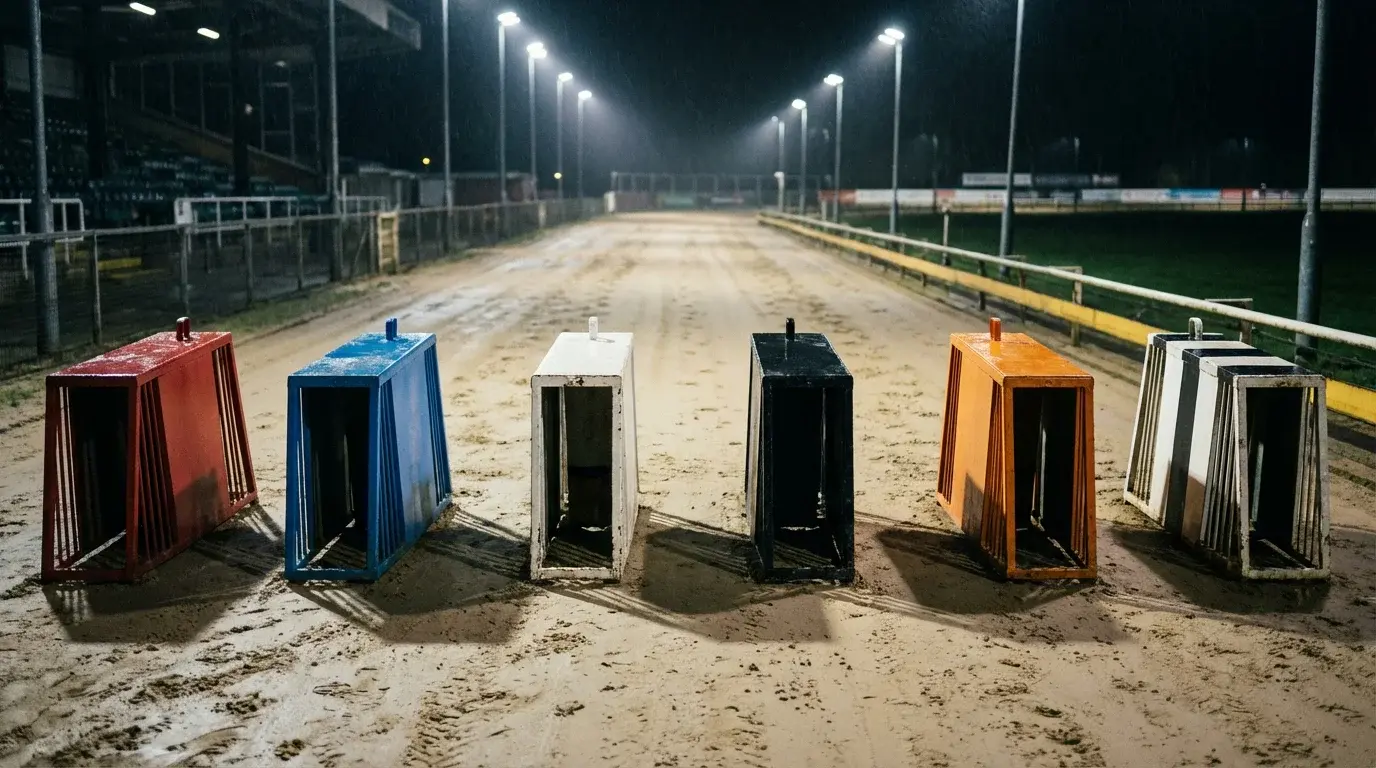
Trap 1 Isn’t Always King — The Numbers Tell a Different Story
Everyone backs trap 1 — but the data is more nuanced than the myth. Ask a casual greyhound punter which trap wins the most and the answer is almost always the same: the inside box. It makes intuitive sense. The dog closest to the rail has the shortest route around the bends, and in a sport where margins are measured in fractions of a second, geometry matters. But when you pull the actual data from thousands of UK races, the picture is more complicated than a blanket rule about inside traps suggests.
Trap 1 does win more races than any other single position across the country. That much is true. What is less often acknowledged is that its advantage is modest — typically a few percentage points above the field average — and that the margin varies enormously depending on the track, the distance, and the quality of the race. At some venues, trap 6 returns a higher win rate than trap 2. At others, the middle boxes produce more winners per race than either extreme. The numbers tell a story, but it is not the simple one most people repeat.
UK-Wide Trap Win Percentages
Across thousands of races at GBGB-registered tracks, the approximate long-term win percentages for each trap break down as follows. These are aggregate figures and will shift slightly year on year, but the overall shape has remained remarkably consistent.
| Trap | Approximate Win % | Colour |
|---|---|---|
| 1 | 19% | Red |
| 2 | 17–18% | Blue |
| 3 | 16–17% | White |
| 4 | 16–17% | Black |
| 5 | 15–16% | Orange |
| 6 | 14–15% | Black & White |
If traps were perfectly even, each would win 16.67% of the time. Trap 1 outperforms that baseline by roughly two to three percentage points, while trap 6 underperforms by a similar margin. That gap might sound small, but over hundreds of bets it is statistically meaningful. The problem is that bookmakers know this too. Dogs drawn in trap 1 are systematically shorter in the market, which often eliminates or even reverses the value advantage. A trap 1 runner offered at 6/4 is not automatically better value than a trap 5 runner at 4/1 just because it has a theoretical two-point edge in win percentage.
The middle traps — 3 and 4 — are often the most overlooked. Their win rates are close to the statistical average, and the market tends to price middle-drawn runners fairly. This means that when a strong form dog lands in trap 3 or 4, its price can occasionally offer genuine value because punters have not inflated it on trap draw alone.
How Trap Bias Varies by Track
At some tracks, trap 6 outperforms trap 1 — and it is not a fluke. The aggregate numbers mask huge variation at individual venues. Track geometry is the primary driver: circumference, bend radius, run-up distance to the first bend, and whether the hare rail sits inside or outside all affect which traps hold an advantage.
Consider the contrast between a tight, short-circumference track and a wide, sweeping one. At a tight track like Romford, the first bend arrives quickly after the start. Dogs in trap 1 get to the rail immediately and can hold their position. Wider-drawn runners have to cover more ground to find their line, and in the compressed space of a tight bend, they lose ground. At such tracks, trap 1 often wins comfortably above 20% of races.
At a larger, more galloping track like Towcester, the picture shifts. The generous bends and longer straights give dogs time and space to settle into their running lines regardless of starting position. Wider-drawn runners are less penalised, and dogs with strong finishing speed can overcome an unfavourable draw because there is more track to make up ground. At Towcester, trap 1 still leads, but the margin over trap 5 or 6 can shrink to one or two percentage points — barely significant over a season.
Hove provides another interesting case. It has a reasonable circumference, and historically its trap statistics have shown a relatively balanced spread across all six positions. Dogs drawn wide have enough room on the bends to hold their line, and the racing there tends to reward form over draw. Contrast that with a venue where trap 1 dominance is stark, and you begin to see why applying a single trap rule across all tracks is a mistake.
The lesson is clear: check the trap stats for the specific track and distance you are betting on. Sites that compile trap statistics by venue and distance offer granular breakdowns that are far more useful than national averages. A 22% win rate for trap 1 at one track and a 16% rate at another represent materially different propositions for your predictions.
Sprint vs Stayer Races: Does Distance Change Trap Advantage?
Distance dilutes the draw — but it never eliminates it entirely. In sprint races, typically run over 260 to 300 metres, the first bend arrives almost immediately. Dogs are still accelerating when they hit the curve, and any positional advantage from the draw is amplified. A railer in trap 1 can establish an inside lead within the first five seconds and may never be headed. In sprints, the draw can be worth several lengths.
Middle-distance races — the standard 480-metre trip that makes up the majority of UK greyhound racing — provide a more balanced test. The longer the race, the more opportunities there are for dogs to find their running line, for pace to tell, and for interference at the first bend to be offset by a strong finish. Trap 1 still leads in win percentage at most tracks over middle distance, but the gap narrows. A strong-form dog drawn wide is less disadvantaged than in a sprint because it has 200 additional metres to make up lost ground.
In staying races — 600 metres and beyond — the draw becomes even less decisive. These races involve multiple bends, and the dynamics shift after each one. A dog that loses ground at the first bend may recover at the second or third. Stamina, pace judgement, and fitness matter more than the initial 50 metres. For stayers, form and class are far stronger predictive factors than trap position.
The practical takeaway is to weight trap draw more heavily in sprint races and less in stayers. If your predictions already account for form and running style, the draw should be the tie-breaker — the factor that tips the balance when two dogs look closely matched on everything else.
How to Factor Trap Stats into Your Predictions
Trap stats are a filter, not a formula. They should never be the primary basis of a selection, but they are too important to ignore. Here is a practical framework for incorporating trap data into your prediction process.
First, analyse form as you normally would. Identify the dogs with the best recent form, the fastest recent times, and the most suitable running style for the race distance. This gives you a shortlist — usually two or three contenders from a six-dog field.
Second, overlay the trap draw. Check whether each contender is drawn in a position that suits its running style. A railer in trap 1 or 2 is well drawn. A railer in trap 5 or 6 is not. A wide runner in trap 5 or 6 has room; in trap 1 or 2, it is likely to drift outward and cause crowding. These are not hard rules — dogs can and do win from unfavourable draws — but they shift the probability.
Third, consult the track-specific trap data for the distance being raced. If you know that trap 3 at a particular track over 480 metres has a 20% win rate while trap 6 has only 12%, that information should influence your confidence level. It might not change your selection, but it could change your stake or your bet type — for example, choosing an each-way bet instead of a straight win if your pick is drawn in a historically weak trap.
The punters who profit long-term from trap statistics are not the ones who blindly back trap 1 in every race. They are the ones who use track-specific data to refine selections they have already made on form. Trap stats add a percentage point or two to your edge when applied correctly. Applied carelessly — as a standalone system — they add nothing but false confidence.
Traps Don’t Pick Winners — But They Tilt the Odds
The trap does not run the race — but it sets the stage. It determines where a dog starts, which path it takes to the first bend, and how much room it has to express its natural running style. Understanding trap bias gives you an edge that most casual punters never bother to acquire. But it is one edge among several, and it works best when layered on top of solid form analysis.
Check the numbers for your track. Factor the draw into your assessment. And then let the dogs do the running.
Get more race analysis at greyhoundpredictions.
Also read our greyhound running styles explained.
