 Available in US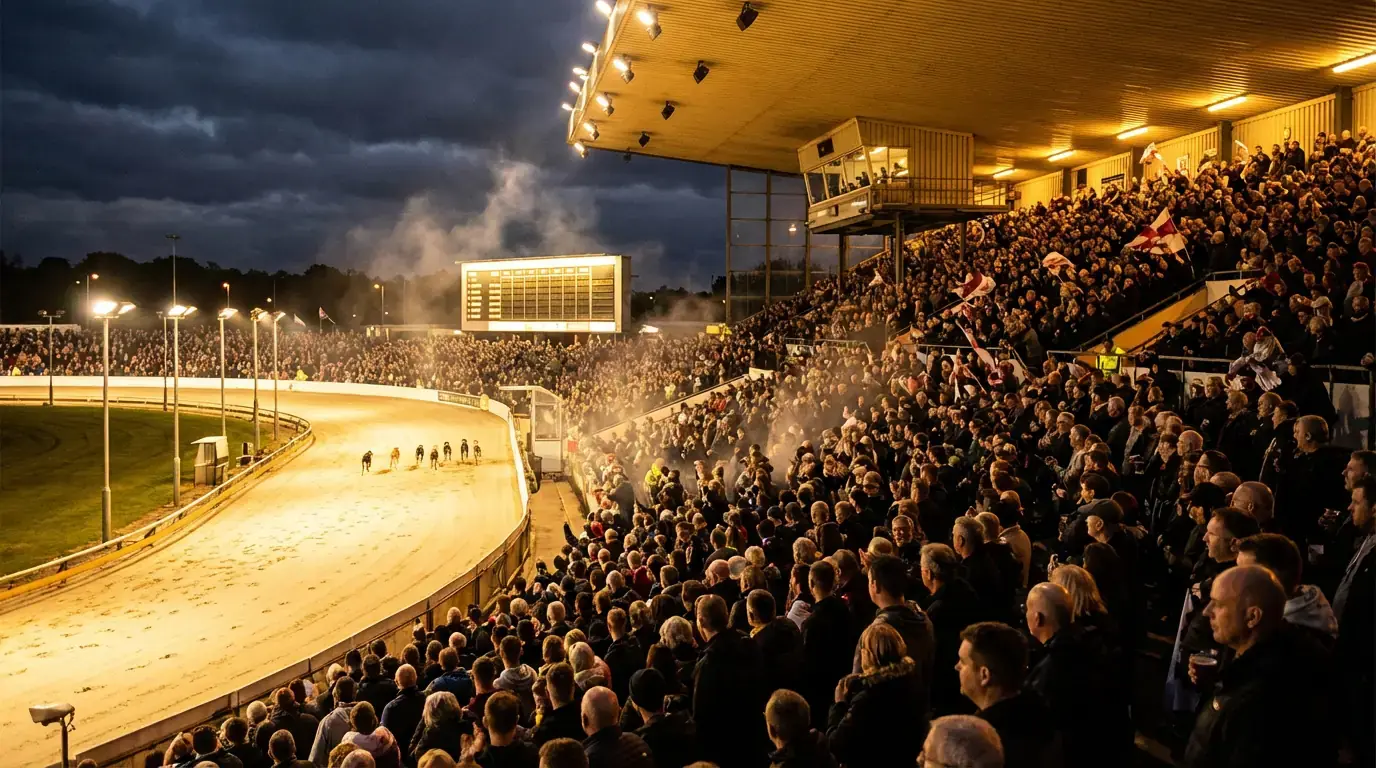
The Race That Defines a Generation of Greyhounds
The Greyhound Derby is the sport’s defining event — its Kentucky Derby, its Champions League final, its Wimbledon. Winning the Derby transforms a dog from a talented racer into a legend. Trainers build entire campaigns around it. Punters who rarely bet on greyhounds suddenly take an interest. And the betting markets, swollen by casual money and heightened attention, create opportunities that do not exist at any other point in the racing calendar.
The Derby combines elite competition, multi-round elimination drama, and a betting landscape that shifts with every heat. Understanding the competition’s history, its format, and the patterns that emerge from decades of results gives you a framework for approaching Derby betting with more precision than the once-a-year punter who picks a name from the final racecard.
A Brief History of the Greyhound Derby
The English Greyhound Derby was first run in 1927 at White City in London, just one year after the introduction of modern oval-track greyhound racing to Britain. It was immediately established as the premier competition in the sport — a status it has held ever since, despite moving between venues as tracks have opened and closed over the decades.
White City hosted the Derby for much of the twentieth century before the event migrated to Wimbledon following White City’s closure in 1984. When Wimbledon itself closed in March 2017 — a moment that many in the sport regarded as a symbolic blow — the Derby moved to Towcester. Towcester’s subsequent financial difficulties forced a relocation to Nottingham in 2019, before the competition returned to Towcester in 2021, where it has been hosted since. The wandering nature of the Derby’s home is a reflection of the broader challenges facing UK greyhound racing, but the event’s prestige has survived every move.
The Derby has produced some of the most celebrated dogs in racing history. Names like Mick the Miller — who won in 1929 and 1930 — became genuine public celebrities. More recent winners have achieved fame within the sport’s dedicated following, though the days of greyhound racers appearing on mainstream news bulletins have largely passed. What has not changed is the competitive standard: the Derby consistently assembles the fastest dogs in the country, and winning it remains the ultimate career achievement for any racing greyhound.
How the Derby Works: Format and Rounds
The Greyhound Derby is a knockout competition run over several weeks, with multiple rounds leading to a six-dog final. The exact format varies slightly from year to year depending on the host venue and the number of entries, but the core structure follows a consistent pattern.
The competition begins with first-round heats. Dozens of dogs are entered, drawn into heats of six runners each. The top two finishers in each heat — and sometimes the fastest losers across all heats — progress to the second round. This elimination process is repeated through the quarter-finals and semi-finals, with the field narrowing at each stage until six dogs remain for the final.
The Derby is typically run over the standard middle distance at the host track — 500 metres at the current venue, Towcester (previously 480 metres at Wimbledon). This means the competition tests speed, tactical ability, and crucially, consistency. A dog that wins one heat brilliantly but runs poorly in the next is eliminated. The dogs that reach the final have demonstrated their ability to perform at the highest level across four or five races over consecutive weeks, which is a test of fitness and temperament as much as raw talent.
The multi-round structure has a direct impact on betting. Early rounds are more predictable because the fields contain a mix of genuine contenders and lower-quality qualifiers. By the semi-finals, every remaining dog is elite, and the margins between them shrink dramatically. The final itself is the most competitive race of the year — six of the best greyhounds in the country, all in peak form, with trap draw and race dynamics often proving decisive.
What Past Derby Results Tell Us
Derby results over the past two decades reveal several recurring patterns that are worth incorporating into your analysis.
Early pace matters in Derby finals. The race is run over a standard distance at a track the dogs have now raced at multiple times during the competition. Dogs that have shown strong trap breaks and fast first-bend sectionals throughout the rounds hold a significant advantage, because they can establish position before the field compresses at the first bend. A Derby final is six elite dogs racing at maximum intensity — the one that reaches the first bend in front has the clearest run to the finish.
Trap 1 has historically been the most successful draw in Derby finals, consistent with its general advantage across UK racing. However, the sample size of finals is small — one per year — so overweighting this data is a mistake. What matters more is which dog is best suited to the trap it has drawn, rather than the trap’s historical win rate in isolation.
Dogs that have progressed through the rounds with relatively comfortable victories — winning by clear margins rather than scraping through — tend to perform better in the final. This makes intuitive sense: a dog that has been working hard to qualify in every round arrives at the final with more miles on the clock than one that has cruised through. Fitness and freshness matter at the end of a long competition.
Trainers with Derby pedigree also deserve attention. Certain kennels have a track record of bringing dogs to peak condition for the Derby final — timing the dog’s campaign so that it arrives at the climactic race in optimal shape. A trainer with multiple Derby finalists over the past decade has demonstrated this skill, and their runner in the current year’s final carries that pedigree advantage.
How to Bet on the Derby
Derby betting evolves through the rounds. In the early heats, the best value often lies in identifying strong dogs drawn in favourable traps against weaker heat opponents. These dogs may be short-priced to win their heat outright, but forecast and tricast bets within heats can be profitable because the finishing order is relatively predictable when a clear class act faces moderate opposition.
As the competition progresses to quarter-finals and semi-finals, the fields tighten and individual race analysis becomes essential. By the semi-final stage, every dog has proven its quality, and the differences between runners are marginal. This is where form from earlier rounds — particularly sectional times and race comments — becomes the primary analytical tool. A dog that has been winning its heats with fast closing sectionals is demonstrating both ability and fitness. One that has been winning through early speed alone may be vulnerable if it meets a closer with the pace to challenge.
For the final itself, treat it as you would any race between closely matched dogs, but give extra weight to trap draw, early pace, and the dog’s progression through the competition. A straightforward win single on your top-rated runner is the cleanest bet. The field of six elite runners also lends itself to forecast betting if you can identify the two most likely to dominate the placings.
Avoid the temptation to bet on the Derby final purely because it is the Derby. The heightened attention draws casual money that can distort prices — sometimes shortening the obvious favourite excessively, sometimes pushing mid-priced runners to longer odds than they deserve. Approach the final with the same analytical discipline you would apply to any Tuesday night BAGS race, and you will be better positioned than the majority of the betting public.
Ante-Post Derby Betting
Ante-post markets for the Greyhound Derby open weeks before the competition begins, offering odds on dogs to win the overall competition rather than individual rounds. These markets represent a different proposition from race-night betting and carry specific risks and rewards.
The reward is price. Ante-post odds are almost always more generous than the starting price on the same dog in the final, because the price reflects not just the dog’s chance of winning the final but also its chance of reaching the final. A dog that is a genuine 3/1 shot to win the final might be available at 10/1 ante-post, because the market is pricing in the probability of elimination in earlier rounds.
The risk is that ante-post bets are typically non-refundable if the dog does not reach the final. If your selection is eliminated in the second round, loses its form, or is withdrawn through injury, your stake is gone. There is no each-way safety net in most ante-post markets, and no BOG protection.
The optimal ante-post strategy is to target dogs that are virtually certain to progress through the early rounds but whose final price will be significantly shorter than the ante-post number. This means backing quality — proven open-class dogs from top kennels with strong recent form. Speculating on unknown quantities at big prices is entertaining but structurally unprofitable, because the attrition rate through multiple rounds makes long-shot ante-post bets extremely low-probability propositions.
If ante-post appeals, consider taking a price after the first round, once you have seen the dog race at the competition venue. A strong first-round performance confirms that the dog handles the track and is in form. The ante-post price will have shortened from the pre-competition number but will still be longer than what you will get on finals night. That timing — after the first round, before the quarters — often offers the best balance between information and price.
Find more race guides at greyhoundpredictions.
Also read our greyhound ante-post betting.
