 Available in US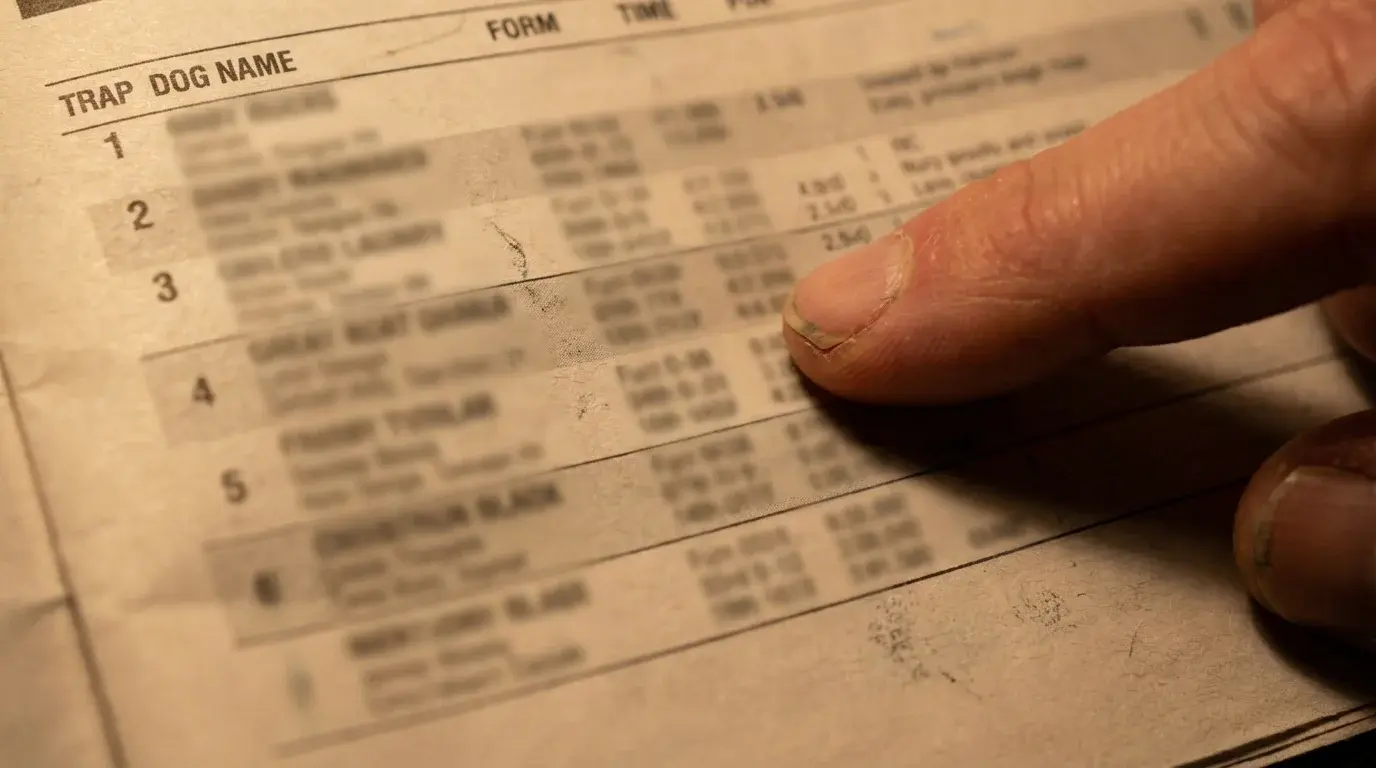
Every Sport Has Its Language — Here Is Greyhound Racing’s
Greyhound racing carries a vocabulary built up over nearly a century of British track culture. Some terms are shared with horse racing, others are unique to the dogs, and a few are so specific to individual aspects of greyhound form that even experienced punters occasionally encounter an unfamiliar phrase. This glossary covers the terminology you are most likely to meet when studying race cards, reading form analysis, or listening to track commentary. It is organised alphabetically for reference rather than narrative — find what you need and move on.
A to F
Ante-post. A bet placed on a competition before the final field is confirmed. Ante-post odds are typically more generous than race-night prices but are usually non-refundable if the dog is withdrawn or eliminated in earlier rounds.
BAGS. Bookmakers’ Afternoon Greyhound Service. The commercial arrangement under which selected tracks host meetings scheduled specifically for off-course betting shop and online coverage. BAGS meetings form the backbone of UK greyhound betting volume.
Best Odds Guaranteed (BOG). A bookmaker promotion guaranteeing that if the starting price is higher than the odds you accepted, you are paid at the better price. Available on greyhounds at selected bookmakers.
Bitch. A female greyhound. Bitches race under the same conditions as dogs but are typically lighter. Their form can be affected by seasonal cycles.
Bumped. Describes a dog that made physical contact with another runner during the race, usually at a bend. Bumping costs momentum and can significantly affect finishing position.
Class. The standard of competition. A dog’s class is reflected by its grade. Moving up in class means facing stronger opponents; dropping in class means facing weaker ones.
Closer. A dog whose running style involves finishing strongly from behind. Closers produce fast closing sectionals and are most dangerous in middle-distance and staying races.
Combination forecast. A forecast bet covering all possible first-and-second finishing orders between three or more selected dogs. The cost is a multiple of the unit stake.
Computer Straight Forecast (CSF). The formula used to calculate the payout on a straight forecast bet in UK racing, based on the starting prices of all runners.
Crowded. A race comment indicating that a dog was squeezed for room between other runners, usually at a bend. Crowding reduces a dog’s ability to maintain its racing line.
Drifter. A dog whose price lengthens in the market before the race, indicating that money is flowing away from it. A drifting price can signal a lack of informed support.
Dutching. Backing two or more dogs in the same race with stakes calculated to produce an equal profit whichever selection wins.
Each way. A bet in two parts: a win bet and a place bet. In six-runner greyhound races, the place part typically pays at one quarter the odds for first and second.
Early pace. A dog’s speed in the opening phase of a race, measured by the first sectional time. Dogs with strong early pace are called front-runners or pace setters.
Form figures. A sequence of numbers showing a dog’s finishing positions in its most recent races. The most recent result appears on the right.
Forecast. A bet requiring you to predict the first two finishers in exact order. A straight forecast covers one order; a reverse forecast covers both.
G to L
GBGB. Greyhound Board of Great Britain. The regulatory body responsible for the governance of licensed greyhound racing in England, Scotland, and Wales.
Going. The condition of the racing surface. Described as fast, normal, slow, or heavy depending on moisture and maintenance. Going affects race times and can favour certain running styles.
Grade. The classification assigned to a dog reflecting its ability level. Grades run from A1 (highest graded level) to A8 or A9 (lowest) at each track. Open races sit above the graded structure.
Grader. The racing manager or official responsible for assigning dogs to grades and specific races at a track.
Green. Describes an inexperienced dog that is still learning to race. A green dog might run erratically, miss the break, or react poorly to crowding.
Handicap (HD). A race where dogs start from staggered trap positions based on their ability, intended to equalise the competition. Less common than graded races.
Hare. The mechanical lure that the dogs chase around the track. The hare runs on a rail, usually on the inside of the circuit.
In season. The reproductive cycle of a bitch, which takes her out of racing for several weeks. Post-season form can be unpredictable for the first few runs back.
Kennel form. The collective recent performance of all dogs trained by a particular trainer. Hot kennel form indicates a trainer whose runners are performing above average.
Lay. To bet against a dog winning, available only on betting exchanges. When you lay a dog, you profit if it loses and pay out if it wins.
Level stakes. A staking approach where the same amount is wagered on every bet regardless of odds, form, or recent results.
Liability. In lay betting, the amount you stand to lose if the selection wins. Calculated as the lay stake multiplied by the odds minus one.
M to R
Middle runner (m). A dog that prefers to race through the centre of the track rather than hugging the rail or running wide. Indicated by (m) on the race card.
Nap. A tipster’s strongest selection of the day. Short for Napoleon, historically the highest-value card in certain betting games.
Open race (OR). A race open to dogs from any track, attracting the highest quality runners. Sub-classified as OR1, OR2, OR3 in descending order of quality.
Overround. The bookmaker’s built-in margin on a race. Calculated by summing the implied probabilities of all runners. An overround above 100% represents the bookmaker’s profit margin.
Pace map. An analytical assessment of how the early stages of a race are likely to unfold, based on each dog’s early speed and trap position.
Place. A finishing position that qualifies for a payout in an each-way bet. In six-runner greyhound races, the standard place terms cover first and second.
Puppy. A greyhound under two years of age. Puppy races are restricted to young dogs and carry separate grading.
Race card. The published information for a meeting, listing each race with the runners’ names, trap numbers, form, trainers, weights, and times.
Racing manager. The official at each track responsible for compiling race fields, assigning traps, grading dogs, and overseeing the meeting.
Railer. A dog that naturally runs close to the inside rail. Railers are most effective from traps 1 and 2. No letter designation on the race card.
Reverse forecast. A forecast bet covering both possible finishing orders of two selected dogs. Costs two unit stakes.
RPGTV. Racing Post Greyhound TV. The dedicated UK television channel broadcasting live greyhound racing coverage.
S to Z
Sectional time. The time recorded for a specific section of a race, typically the run to the first bend, the middle section, or the closing phase. Sectionals reveal how a dog distributed its speed.
Slow away. A race comment indicating that a dog broke slowly from the traps, losing ground in the opening strides.
SP (Starting Price). The final odds on a dog at the moment the traps open. Used to settle bets when no fixed price was taken.
Stayer. A dog that races over longer distances, typically 600 metres and above. Stayers require greater stamina and tactical racing ability.
Steam. A significant shortening of a dog’s price in the market, indicating heavy support. A “steamer” is a dog whose odds are contracting rapidly.
Strike rate. The percentage of selections that win. Used to evaluate tipster performance and personal betting records.
Tissue price. The bookmaker’s initial assessment of the correct odds for each runner, compiled before the market opens.
Tote. The pool betting operation at UK greyhound tracks. Tote dividends depend on the total money wagered and how it is distributed, rather than fixed odds.
Trap. The numbered starting box from which each dog begins the race. UK greyhound races use six traps, colour-coded from 1 (red) to 6 (black and white stripes).
Trap challenge. A bet where you back whatever dog occupies a specific trap number in every race at a meeting.
Trial. A non-competitive run, usually solo or paired, used to assess a dog’s fitness or time at a specific track before racing competitively.
Tricast. A bet requiring you to predict the first three finishers in exact order. Combination tricasts cover all possible permutations of three selected dogs.
Value bet. A bet where the odds offered are higher than the true probability of the outcome, giving the bettor a positive expected value.
Wide runner (w). A dog that naturally runs on the outside of the track. Indicated by (w) on the race card. Best suited to traps 5 and 6.
The Glossary as a Working Tool
This is not a list to memorise and forget. Bookmark it, refer to it when an unfamiliar term appears on a race card or in a form analysis, and over time the vocabulary will become second nature. The language of greyhound racing exists because it describes real phenomena — trap bias, kennel form, closing speed — that directly affect the outcome of every race. Understanding the words means understanding the sport. Understanding the sport is the first step toward betting on it profitably.
Find more racing guides at greyhoundpredictions.
Also read our greyhound betting for beginners.
