 Available in US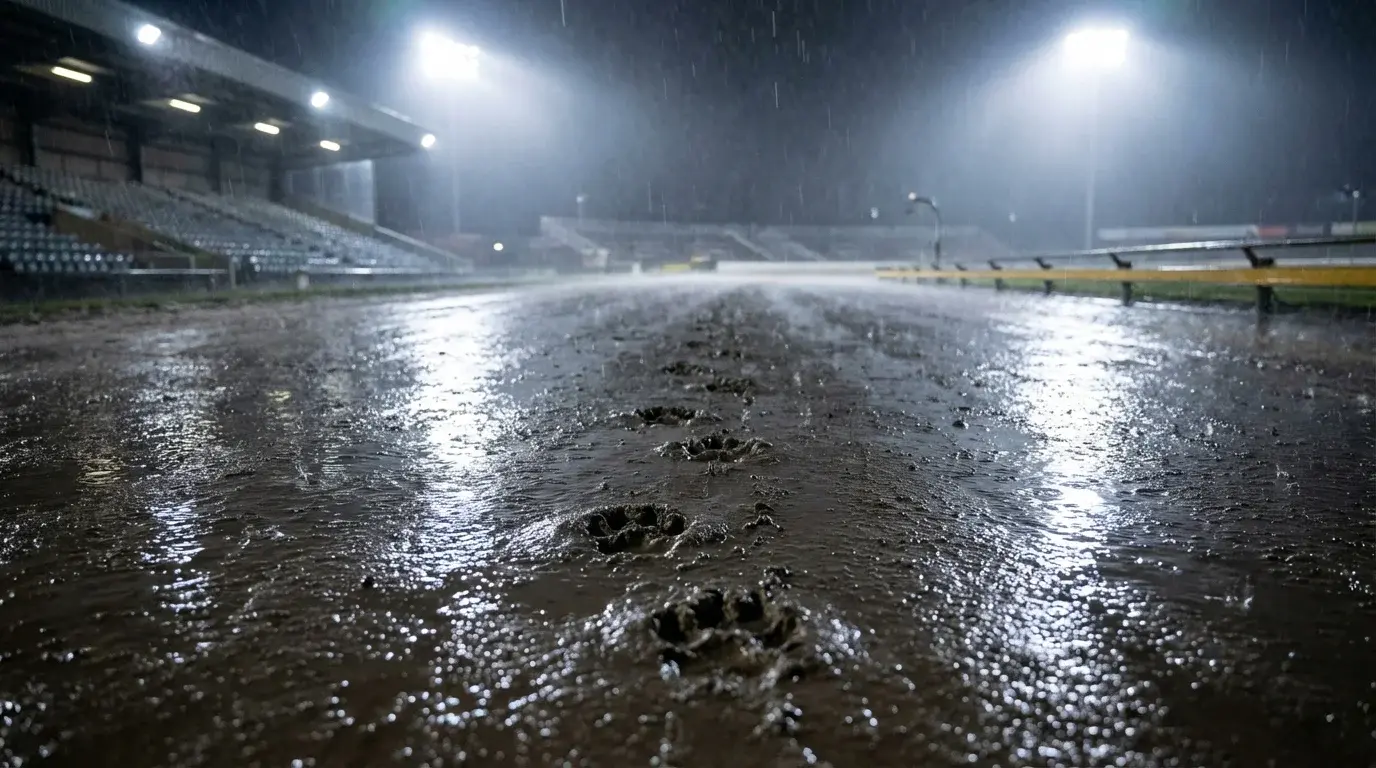
The Track Under Their Feet Changes Everything
Sand, rain, and a headwind — three words that can rewrite an entire card. Greyhound form is never produced in a vacuum. Every time, every finishing position, and every run-style observation on a race card was recorded under a specific set of conditions, and when those conditions change, so does the competitive picture. A dog that dominates on dry, fast sand in August may struggle when January rain turns the same surface into something heavier and slower.
Yet going conditions remain one of the most underused variables in greyhound prediction. Most punters study form, check trap draws, compare times — and then ignore the fact that tonight’s track is running two-tenths slower than the evening those times were recorded. That disconnect between historical data and current conditions is a consistent source of value for anyone willing to account for it.
Track Surfaces Across UK Greyhound Racing
The vast majority of UK greyhound tracks use a sand-based surface, either pure sand or a sand-and-clay mixture. This is the modern standard, adopted because sand is far easier to maintain than the grass surfaces that defined the sport’s early decades. A few tracks have experimented with proprietary surface blends, but sand in some form covers nearly every circuit in the GBGB-registered network.
The specific composition of the sand affects how it responds to weather. A coarser sand drains faster after rain, meaning the track returns to normal going more quickly. A finer sand or sand-clay mixture retains moisture longer, producing slower conditions that persist well after the rain has stopped. Each track has its own drainage characteristics, and punters who race at a single venue regularly develop an intuitive feel for how quickly conditions shift after rainfall. That knowledge is difficult to quantify but immensely practical.
Beyond the surface itself, track maintenance plays a role. Before every meeting, the racing surface is watered and rolled to ensure a consistent, safe running area. The amount of water applied depends on the prevailing weather — more in dry spells to prevent the sand from becoming too loose, less when natural rainfall has already softened the surface. The result is that track conditions are never entirely static, even within the same week at the same venue.
Fast Going: When Speed Rules
Fast going occurs when the track surface is dry, firm, and compacted — typically during summer months or after a sustained dry spell. Under these conditions, dogs produce their quickest times. The sand offers maximum grip, allowing greyhounds to accelerate harder out of the traps and maintain top speed through the bends.
Early-pace dogs thrive on fast going. The firm surface supports explosive trap breaks, and a dog that gets to the front quickly can hold its lead because the track rewards sustained speed. Railers benefit disproportionately on fast ground, because the inside line — already the shortest route — is also the fastest when the surface is at its firmest near the rail.
For bettors, fast going is where best times are most relevant. If a dog has a recorded best of 29.20 and the track is running fast, there is a realistic chance it will approach that figure. Compare that to slow going, where the same dog might be 0.40 to 0.60 seconds off its best simply because of the surface. When conditions are fast, raw speed becomes the primary differentiator between runners, and the fastest dog on the card has a stronger claim than usual.
Track records are almost always set on fast going. It is also worth noting that very fast conditions can occasionally produce unexpected interference. When all six dogs break sharply on a firm surface, the first bend can become more congested than usual, because the field is bunched tightly rather than strung out. In those circumstances, dogs drawn wide can benefit from the space to avoid the scrum.
Slow and Wet Going: A Different Race
When rain saturates the track surface, everything changes. The sand becomes heavier, absorbing the impact of each stride and slowing dogs down. Times lengthen by anywhere from 0.20 to 0.60 seconds depending on how wet the surface is. The going is typically described as slow or heavy, though UK greyhound racing does not use the same formalised going descriptions as horse racing — conditions are simply acknowledged as faster or slower than standard.
Wet going favours a specific type of runner. Heavier dogs — those at the top end of the weight range for their sex — tend to cope better with a rain-softened surface. Their extra mass provides more traction on the heavy sand, whereas lighter dogs can struggle to find grip, particularly through the bends. Dogs with a powerful, driving running action rather than a light, flowing stride also adapt better to soft ground.
Finishers — dogs that close strongly in the second half of the race — gain an advantage in wet conditions. The heavy surface saps the early-pace dogs more quickly, blunting their ability to sustain a lead. By the time the field reaches the second or third bend, the dogs that started fast are tiring, and the closers, whose running style demands less initial energy, are still moving strongly. If your card analysis identifies a strong closer drawn in an outside trap on a wet night, that is a live contender regardless of what its dry-track form suggests.
A practical note: when the going is genuinely heavy, throw out best times entirely. They were recorded under conditions that no longer exist. Focus instead on the dogs’ ability to handle the conditions, their weight, and their running style. Previous performances on wet going — if visible in the form line — are far more relevant than any time recorded on a scorching July evening.
Adjusting Your Predictions for Conditions
The simplest approach to adjusting predictions for going conditions is a two-step process. First, establish what the going is likely to be for tonight’s meeting. Check the weather forecast for the track location. Check social media or track websites — some venues post going reports before racing. If it has rained significantly in the past 24 hours and more is forecast, assume slow going. If it has been dry for days, assume fast.
Second, re-evaluate your shortlisted runners through the lens of the conditions. For each dog, ask: does its profile suit the going? A lightweight, early-pace railer that has produced all its best form on fast ground is a higher-risk selection on a wet night. A heavier, wide-running finisher with modest recent form might suddenly become the most dangerous dog in the race if the surface is soft enough to negate the speed of the front-runners.
Time adjustments are useful but approximate. A rough rule of thumb is to add 0.30 to 0.40 seconds per standard race distance when going shifts from normal to slow. This does not give you precise comparisons, but it helps prevent the trap of dismissing a dog because its recent time looks slow when the conditions on that day were genuinely heavy.
More important than any formula is the habit of checking conditions before you check form. If you make your selections on a dry-weather card and then discover at post time that the track is waterlogged, your entire analysis may be compromised. Building a weather check into the first step of your prediction routine — before you study the runners — ensures that every subsequent judgement is grounded in current reality rather than historical data from different conditions.
A Five-Minute Weather Routine That Sharpens Every Bet
Weather does not require specialist knowledge. It requires a habit. Here is a five-minute routine that will immediately improve the accuracy of your greyhound predictions on nights when conditions deviate from the norm.
Check the forecast for the track location from midday onward. Note the temperature, wind speed, and any rainfall expected before or during the meeting. High winds can affect trap-break behaviour — dogs are occasionally unsettled in blustery conditions, particularly at open-air venues. Sub-zero temperatures can harden the surface, producing fast times similar to dry summer going.
Look at recent race results at the venue. If last night’s times at the same track were 0.30 seconds slower than the previous week across the board, the surface is running slow. If they were in line with seasonal averages, conditions are normal.
Adjust your shortlist. Promote closers and heavier dogs on slow going. Promote speed dogs and railers on fast going. If conditions are normal, trust your standard form analysis without adjustment. That is the entire process. Five minutes, no technology beyond a weather app and a results page, and a measurably sharper set of predictions at the end of it.
Get more race analysis at greyhoundpredictions.
Also read our greyhound sectional times.
