Best Greyhound Betting Sites – Bet on Greyhounds in 2026
Loading...
Odds Are Not Just a Price — They Are a Probability in Disguise
Every set of greyhound odds tells you two things simultaneously. The first is obvious: how much you stand to win. The second is hidden in plain sight: what the market believes the dog’s chances of winning actually are. Most punters only see the first. The ones who profit long-term see both.
The UK betting market uses three different odds formats — fractional, decimal, and exchange — and they all express the same information in different ways. Knowing how to read all three, convert between them fluently, and extract the implied probability from any price is a foundational skill. Without it, you are placing bets without fully understanding what you are buying.
Fractional Odds: The Traditional UK Format
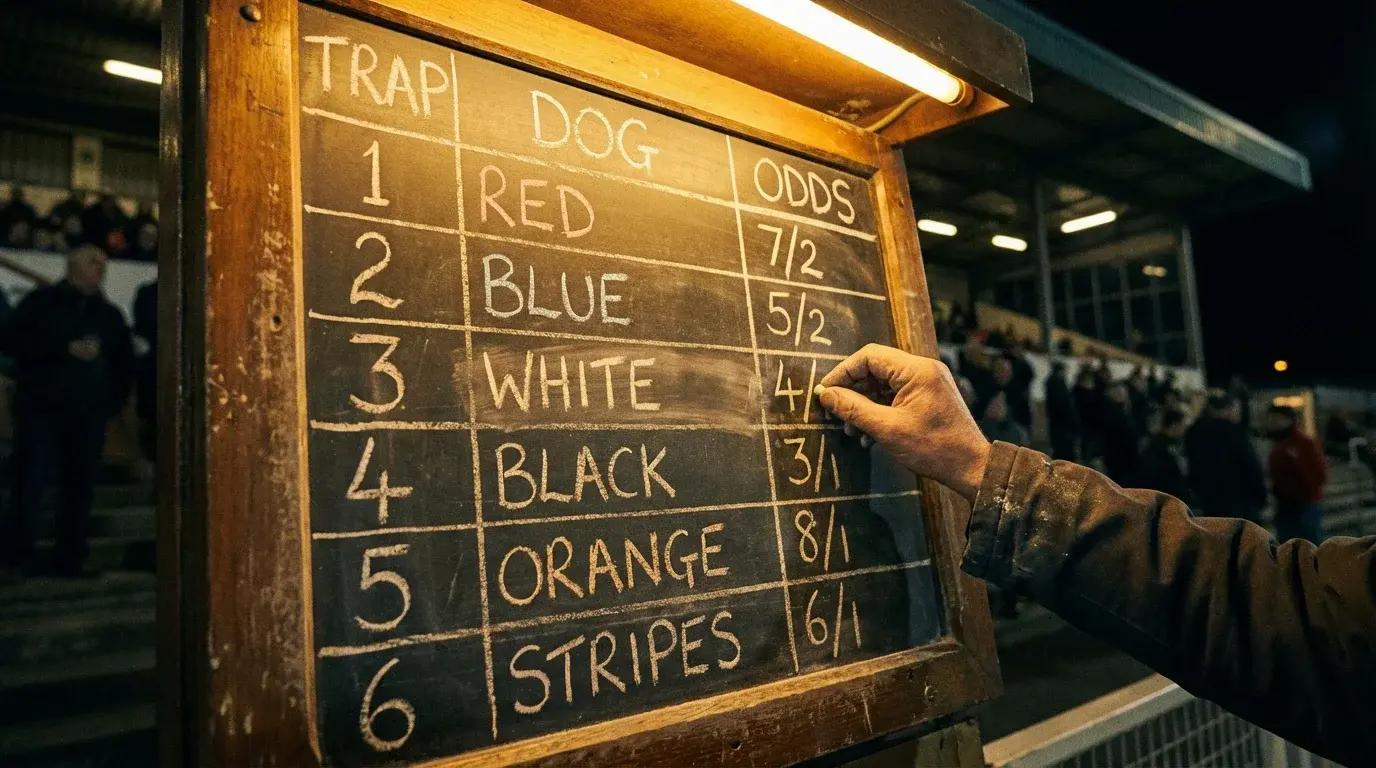
Fractional odds are the format most British punters grew up with. They are written as two numbers separated by a slash: 3/1, 5/2, 11/4, 4/6. The first number tells you the profit relative to the second number, which represents the stake. At 3/1 — read “three to one” — you win three pounds profit for every one pound staked. At 5/2, you win five pounds for every two pounds staked, or two pounds fifty per pound.
Odds-on prices are fractions where the first number is smaller than the second: 4/6, 1/2, 8/13. These indicate a dog the market considers more likely than not to win. At 4/6, you stake six pounds to win four. Your total return is ten pounds, but you have risked six to make four — a reflection of the market’s belief that this dog has a better than fifty-percent chance of winning.
The appeal of fractional odds is tradition and quick mental arithmetic for simple prices. Everyone knows that 3/1 means triple your stake. But fractional odds become awkward with complex fractions — 11/8, 100/30, 85/40 — where the relationship between stake and profit is not immediately intuitive. This is one reason the industry has gradually shifted toward decimal pricing on digital platforms.
To extract implied probability from fractional odds: divide the second number by the sum of both numbers. At 3/1: 1 / (3+1) = 0.25, or 25%. At 5/2: 2 / (5+2) = 0.286, or roughly 28.6%. At 4/6: 6 / (4+6) = 0.60, or 60%. This conversion is the single most useful calculation in betting, because it translates the price from “how much will I win?” into “how likely does the market think this dog is to win?” — and the second question is the one that matters for finding value.
Decimal Odds: Cleaner, Simpler, Global
Decimal odds express your total return per unit staked, including the stake itself. Odds of 4.0 mean a one-pound bet returns four pounds total — three in profit plus your one-pound stake back. Odds of 3.5 return three pounds fifty. Odds of 1.67 return one pound sixty-seven, making them the decimal equivalent of the fractional 4/6.
The mathematical clarity of decimal odds is their greatest advantage. Comparing two prices is instant: 4.0 is a better payout than 3.5, and 6.0 is better than both. No mental gymnastics required. This makes decimal odds particularly useful when comparing prices across multiple bookmakers — a routine habit for anyone serious about maximising returns.
Decimal odds are standard on European betting platforms and are the default on most exchanges. Every UK bookmaker offers a decimal display option in the account settings, and if you are doing any kind of quantitative analysis — calculating expected value, comparing odds, or running a staking system — decimal is the format to work in. The maths is simply cleaner.
Implied probability from decimal odds is the simplest conversion of all: 1 divided by the decimal odds. At 4.0: 1/4.0 = 0.25, or 25%. At 2.5: 1/2.5 = 0.40, or 40%. At 1.5: 1/1.5 = 0.667, or 66.7%. If this probability is lower than your own estimated probability of the dog winning, the bet offers value. If it is higher, it does not.
Exchange Odds: The Market Without the Middleman
Betting exchanges — Betfair being the dominant platform for UK greyhounds — display odds in decimal format but operate on a fundamentally different model from traditional bookmakers. On an exchange, you are not betting against the bookmaker; you are betting against other punters. The odds are set by supply and demand, not by a trader in a back office.
Exchange odds tend to be more accurate reflections of true probability than bookmaker odds, because the market is driven by thousands of independent assessments rather than a single pricing team. They also tend to be slightly more generous on the back side — the odds available for backing a dog to win — because the exchange does not build the same margin into its prices that bookmakers do. Instead, the exchange charges a commission on net winnings, typically six percent on Betfair for sport and international racing markets.
The exchange also offers the ability to lay — to bet against a dog winning. This is expressed as a separate set of odds. The back price is what you receive if you bet on the dog to win. The lay price is what you offer if you bet against it. The gap between the two is the spread, and it functions similarly to the bid-ask spread in financial markets. A tight spread indicates a liquid, efficient market. A wide spread indicates uncertainty or low trading volume.
For greyhound bettors, exchange odds are most useful in two scenarios. First, when comparing prices: the exchange frequently offers better back odds than fixed-odds bookmakers on mid-priced runners, because the absence of a bookmaker margin means more of the money flows back to winning bettors. Second, when laying: the exchange is the only platform that allows you to bet against a dog, which opens an entire strategic dimension unavailable through traditional bookmakers.
Converting Between Formats
Fluency across all three formats means you never miss a price comparison. The conversions are straightforward.
Fractional to decimal: divide the first number by the second and add 1. At 3/1: (3/1) + 1 = 4.0. At 5/2: (5/2) + 1 = 3.5. At 4/6: (4/6) + 1 = 1.667.
Decimal to fractional: subtract 1, then express as a fraction. From 4.0: 4.0 – 1 = 3, so 3/1. From 3.5: 3.5 – 1 = 2.5, so 5/2. From 1.667: 1.667 – 1 = 0.667, so approximately 4/6.
Either format to implied probability: as covered above, decimal is simplest. Divide 1 by the decimal odds. For fractional, divide the denominator by the sum of numerator and denominator.
Most punters memorise the common fractional-to-decimal equivalents and rely on mental shortcuts rather than calculating every price from scratch. The key pairs are: evens = 2.0, 2/1 = 3.0, 3/1 = 4.0, 5/1 = 6.0, 10/1 = 11.0, 5/2 = 3.5, 7/2 = 4.5, 9/2 = 5.5. Knowing these by heart covers the majority of greyhound betting prices.
Which Format Should You Use
Use whatever format your brain processes fastest — there is no analytical advantage to one over another, since they all convey identical information. That said, most serious bettors eventually migrate to decimal for their working analysis because the arithmetic is cleaner, and because exchange platforms and odds comparison sites default to decimal display.
If you bet primarily in shops or with traditional UK bookmakers, fractional odds remain the lingua franca and there is no reason to abandon them. If you use exchanges, run staking calculations, or compare prices across multiple platforms, decimal odds will save you time and reduce the risk of arithmetic errors.
The format matters far less than the habit of converting every price to an implied probability before you bet. That conversion — which takes two seconds regardless of the format — is what separates punters who understand what they are paying for from those who are simply looking at a number and hoping it is big enough.