 Available in US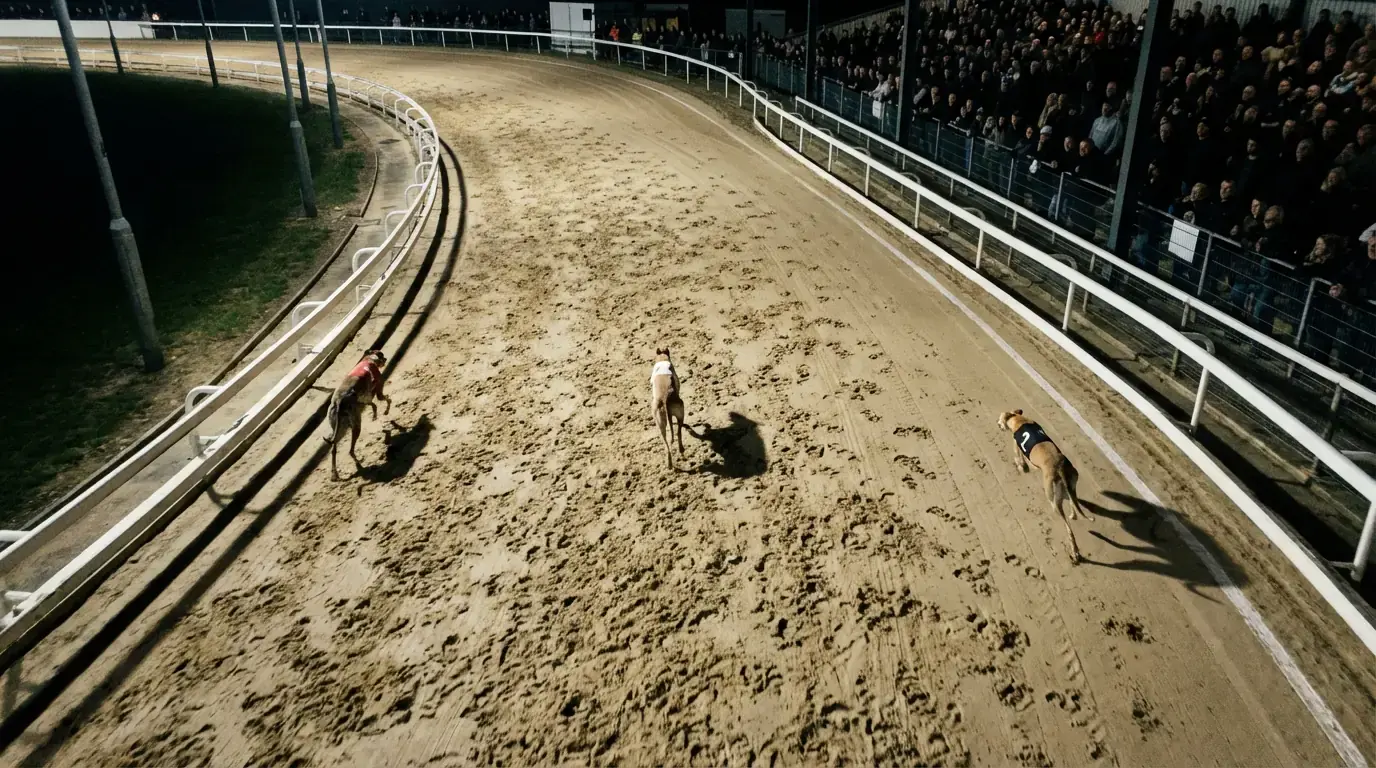
Every Dog Has a Line — Your Job Is to Know It
A greyhound’s running style is not a matter of choice on race night. It is hardwired — a product of temperament, physical build, and thousands of repetitions in training and racing. Some dogs instinctively hug the inside rail from the moment the traps open. Others drift wide, preferring room on the outside to avoid traffic. A third group sits somewhere in between, running through the middle of the pack and relying on tactical speed rather than track position.
These running styles — railer, middle runner, and wide runner — are printed on every UK race card, usually as a letter after the dog’s name. No letter means a railer. An (m) means a middle runner. A (w) means a wide runner. Three characters that most punters glance at and forget. That is a mistake, because running style intersects directly with trap draw, track geometry, and race dynamics to produce a prediction angle that raw form analysis alone will miss.
The Railer: First to the Rail, First to the Bend
Railers are the speed merchants of greyhound racing. Their instinct is to break from the traps and drive toward the inside rail as quickly as possible, securing the shortest path around the first bend. In a sport where the first bend often determines the final result, that positional advantage is significant.
A railer drawn in trap 1 or 2 is in its ideal starting position. It has a direct line to the rail with minimal interference. When a strong-form railer lands in trap 1 at a track with tight bends and a short run to the first turn, that is one of the most bankable scenarios in greyhound betting. The combination of natural instinct, favourable draw, and track geometry all point the same way.
The picture changes when a railer draws wide — trap 4, 5, or 6. Now it has to cross one, two, or three other dogs to reach its preferred line. That crossing movement causes two problems. First, it costs time. The dog is not running in a straight line; it is angling inward while also accelerating. Second, it creates interference risk. If another dog is occupying the space the railer wants, crowding at the first bend becomes likely. Both dogs lose momentum, and a dog running freely on the outside can sweep past them both.
When evaluating a railer, always cross-reference its draw with the race dynamics. If it is the only railer in the field — the rest are middle or wide runners — even a wide draw may not matter, because there is no competition for the rail. But if two or three dogs want the same inside line, the one drawn widest is at the biggest disadvantage.
The Middle Runner: Flexible but Exposed
Middle runners are the tacticians. They do not commit to the rail or the outside; instead, they thread a path through the middle of the pack, relying on pace and race-reading rather than track position. At their best, middle runners can adapt to whatever unfolds around them. At their worst, they get squeezed from both sides.
The advantage of a middle runner is flexibility. Drawn in trap 3 or 4, it is already in its comfort zone with dogs on either side. It does not need to cross traffic to find its line, and it can react to crowding at the first bend by adjusting slightly inward or outward without losing much ground. This makes middle runners less affected by draw than railers or wide runners, which is why their win rates across different trap positions tend to be more uniform.
The disadvantage is exposure. A middle runner can be buffeted from both sides — squeezed by a railer cutting in from a wider trap and a wide runner drifting out from a narrower one. In tightly packed fields where every dog breaks at similar speed, the middle runner is the most likely to encounter interference. Watch for comments in the form line like “crowded bend one” or “hampered middle” — these are the telltale signs of a middle runner whose form figures are worse than its actual ability.
When a middle runner has had a string of runs disrupted by traffic, the market often overreacts. Its form figures look poor, but the underlying ability may still be strong. If it draws in trap 3 or 4 in a race where the runners on either side are not going to cause trouble — perhaps one is a clean railer and the other a clean wide runner — the middle runner gets a clear passage. That is the kind of race where an underpriced middle runner can win at generous odds.
The Wide Runner: Room to Move, Ground to Cover
Wide runners are the dogs that want open space on the outside of the track. They avoid the rail, avoid the pack, and run their own race in clean air. The trade-off is obvious: they cover more ground. Every bend run wide adds distance, and over a 480-metre race with two or four bends, that extra yardage can cost a length or more.
A wide runner drawn in trap 5 or 6 is well placed. It has immediate access to the outside running line without needing to negotiate traffic. If it has strong early pace, it can establish a lead on the outside and hold its position through the bends by running wide but fast. If it is a closer — a dog that runs on in the second half of the race — a wide draw gives it room to make a late challenge without being blocked by tiring dogs on the rail.
Wide runners drawn in traps 1 or 2 face problems. Their instinct to drift outward conflicts with their starting position on the inside. In the first few strides, they will move away from the rail, cutting across the paths of dogs in traps 3, 4, and 5. This almost always causes interference, and the wide runner itself can lose momentum in the process. A wide runner drawn in trap 1 is one of the most clearly disadvantaged combinations in greyhound racing.
The value angle with wide runners lies in distance. In sprint races, wide runners are at a structural disadvantage because there is not enough track to compensate for the extra ground they cover. In middle-distance and especially staying races, the calculus shifts. A strong-finishing wide runner in a 600-metre race has ample time and space to overcome the draw, and its tendency to run in clear air means it avoids the bunching and interference that can derail inside runners at the bends.
Matching Running Style to Trap Draw
The single most actionable piece of analysis you can do with running style data is to check whether each dog’s style matches its trap draw. This takes thirty seconds per race and eliminates a significant chunk of avoidable losing bets.
The ideal draw for each running style is straightforward. Railers want traps 1 and 2. Middle runners perform best from traps 3 and 4. Wide runners suit traps 5 and 6. This structure follows from the GBGB seeding system, where the racing manager assigns traps based on each dog’s preferred running line. When a dog is drawn in its preferred zone, it can express its natural running style from the start. When it is drawn against type, it has to either fight to find its line — costing time and risking interference — or run an unnatural race from a position it is not comfortable in.
The practical application is to treat mismatched draws as risk factors, not disqualifications. A strong-form railer drawn in trap 4 is not a scratch from your shortlist, but it carries more risk than the same railer drawn in trap 1. If you are choosing between two similarly rated dogs and one is well drawn while the other is not, running style and draw alignment should break the tie.
Also pay attention to the full field composition. A railer in trap 3 is less disadvantaged if traps 1 and 2 contain middle or wide runners who will not contest the rail. In that scenario, the railer has a clear path inward. Conversely, if traps 1, 2, and 3 are all occupied by railers, expect first-bend crowding regardless of who is best drawn. In these races, the wide runner in trap 6, running in uncontested space, can sweep around the chaos and win at a price.
When Styles Collide: Reading Race Dynamics
The races that produce the biggest upsets — and the best betting opportunities — are the ones where running styles collide at the first bend. When multiple railers are drawn wide and multiple wide runners are drawn narrow, the first five seconds of the race become a scramble for position. Dogs cross paths, interference occurs, and the formbook goes out the window.
These races are harder to predict but not impossible to exploit. The key is identifying which dog has the clearest route to its preferred line. If one runner — of any style — is drawn perfectly while the rest are compromised, that positional advantage can outweigh a slight deficit in raw form. The market tends to price these races on form alone, which is exactly when running-style analysis pays off.
Running style is not glamorous analysis. It does not require proprietary data or complex models. It requires spending an extra thirty seconds per race checking three letters on a card — and thinking about what they mean when six dogs leave the traps at the same time.
Get more form guides at greyhoundpredictions.
Also explore our form guide.
