Best Greyhound Betting Sites – Bet on Greyhounds in 2026
Loading...
The Race Within the Race: What Sectional Times Reveal
A finishing time tells you how fast a dog ran from start to finish. A sectional time tells you how it ran — where it was fast, where it was slow, and what that means for the next race. Two dogs can clock identical overall times of 29.50 over 480 metres and be fundamentally different animals. One might have blazed through the first 270 metres and faded in the final straight. The other might have been moderate early and closed like a train. The finishing time treats them as equals. The sectionals tell you they are not.
Sectional times — also called splits — break a race into segments, typically the run to the first bend, the middle section, and the closing stage. Not every track publishes full sectionals, and not every form provider includes them, but where they are available, they represent one of the most underused data points in greyhound betting. Punters who learn to read them gain an understanding of race dynamics that raw form figures and overall times simply cannot provide.
What Sectional Times Actually Measure
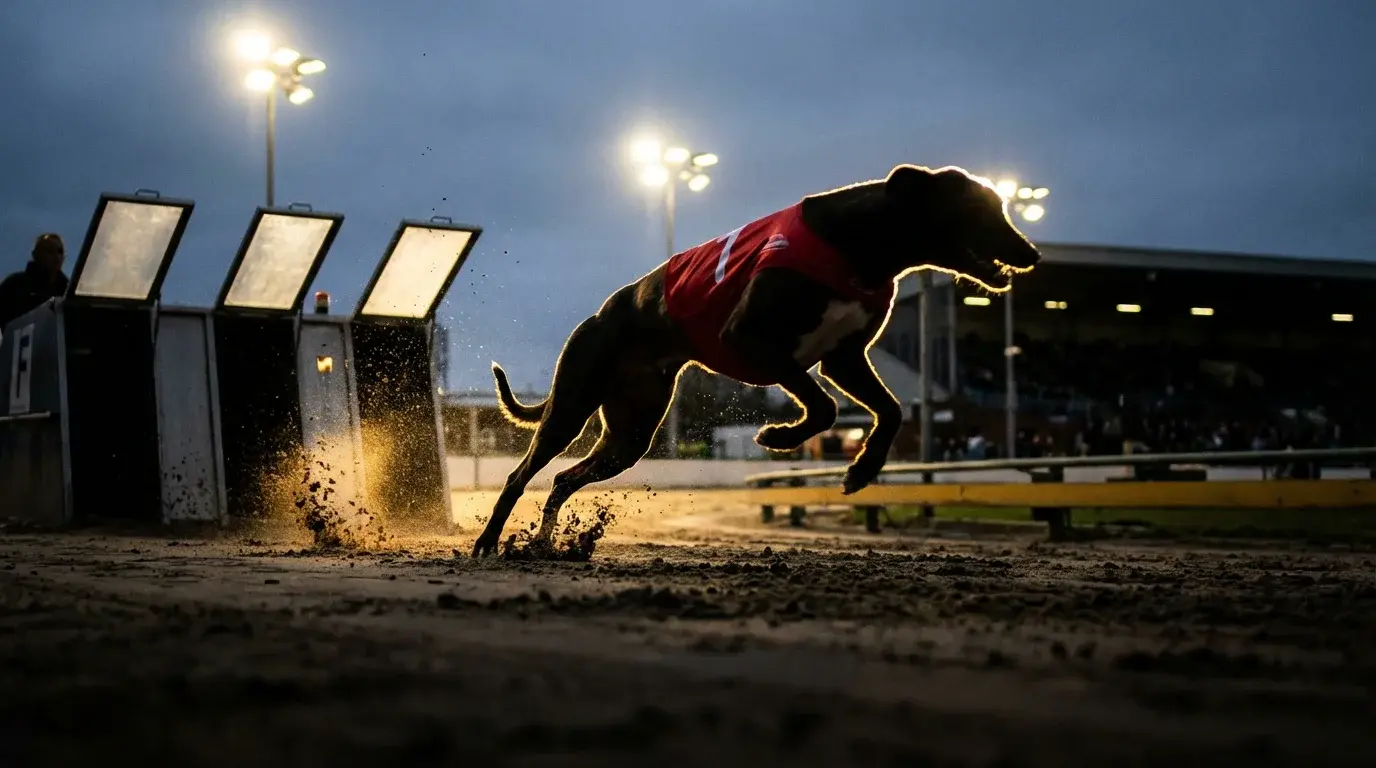
In UK greyhound racing, the most common sectional split is the time to the first bend — sometimes called the “run-up” or “sectional one.” This measures how quickly a dog covers the distance from the traps to the first timing point, usually at or just before the first bend. It is the purest measure of a dog’s early pace: its trap break speed, its acceleration, and its ability to reach racing speed before the field compresses into the first turn.
The second sectional typically covers the middle portion of the race — from the first bend through to the back straight or second bend. This segment captures how well a dog handles the bends, whether it maintains momentum through the turns, and whether it gains or loses position in the middle stages where tactical running matters most.
The third sectional — the closing split — measures the final section from the last bend to the finish line. This is where stamina, fitness, and finishing ability show themselves. A dog with a fast closing split is running on strongly at the end of the race. A dog with a slow closing split relative to its field is fading, which might indicate a stamina limitation, a fitness issue, or simply that it spent too much energy in the early stages.
Not all tracks record all three sectionals. Some only publish the first-bend time and the overall time, leaving you to calculate the back-end split by subtraction. Others provide a full three-way breakdown. Where available, the full set is invaluable. Where only the first sectional exists, it still carries significant predictive weight because the run to the first bend is the most decisive phase of a greyhound race.
Early Pace: Why the First Sectional Matters Most
In greyhound racing, the first bend shapes the entire race. Dogs that reach it first in a strong position — leading or close to the lead on their preferred running line — win at a significantly higher rate than dogs that are caught in traffic. The first sectional is the numerical measure of which dog gets to that critical point fastest.
A dog with a consistently fast first sectional is an early-pace runner. It breaks sharply from the traps, accelerates quickly, and reaches the first bend at or near the front of the field. When this dog draws in a trap that suits its running style — a railer in trap 1 or 2, a wide runner in trap 5 or 6 — the combination of natural speed and positional advantage is formidable.
But early pace alone does not guarantee results. A dog can post the fastest sectional to the first bend and still lose if it cannot sustain that speed. This is where comparing the first sectional against the closing sectional becomes revealing. If a dog consistently runs 5.80 seconds to the first bend but its closing sectional is 0.30 seconds slower than the field average, it is burning energy early and fading late. Against strong closers, that pattern is a recipe for getting caught in the final strides.
For prediction purposes, a fast first sectional is most valuable in sprint races, where the entire contest hinges on the opening phase. In middle-distance races, it remains important but must be weighed against the closing split. In staying races, early pace is often the least important sectional — stamina and the ability to maintain a steady rhythm through multiple bends matter far more.
Closing Speed: The Split That Finds Late Value
Closing speed — how fast a dog runs the final section of the race — is the sectional that the market most frequently undervalues. The reason is simple: punters tend to watch the front of the race. The dog that leads into the final bend gets the attention; the dog that finishes strongest from mid-pack often goes unnoticed, especially if it runs into third or fourth rather than snatching the win.
A dog with a fast closing split relative to its field is doing one of two things. Either it is genuinely the fittest dog in the race, sustaining speed while others tire. Or it is a natural closer — a running style that produces moderate early pace followed by a strong late effort. Both scenarios create betting opportunities.
The fitness scenario is particularly interesting for predictions. A dog that has been running fast closing splits across its last three or four races is likely at or near peak condition. It is finishing races strongly, not tiring, and may be improving. If it is simultaneously being moved up in grade — and its closing speed is still matching or exceeding the field — that is a dog on an upward trajectory that the market may not have fully priced in.
The closer scenario offers value in specific race dynamics. When a race features two or three confirmed front-runners who are likely to contest the early lead, the pace at the front will be fast and potentially unsustainable. A confirmed closer drawn wide — out of the first-bend traffic — can sweep past tiring dogs in the home straight. If you can identify races where the early pace will be contested and your closer has the sectionals to prove it finishes strongly, you have an edge that form figures alone cannot provide.
Comparing Sectionals Across the Field
The real power of sectional analysis emerges when you compare splits across all six runners in a race. Instead of looking at each dog in isolation, lay out their first-bend times and closing splits side by side. The patterns that emerge tell you the probable shape of the race before it is even run.
If one dog has a first sectional that is 0.10 to 0.15 seconds faster than anything else in the field, it is highly likely to lead into the first bend. That dog sets the pace. Whether it wins depends on its ability to sustain that speed — which is where its own closing split comes in.
If two dogs share similarly fast first sectionals and are drawn on the same side of the track, expect a contested lead and potential first-bend interference. In this scenario, the dog drawn closest to its preferred line has the advantage, but both may compromise each other. The runner that benefits most is often the one sitting third or fourth early — out of trouble, saving energy, and positioned to capitalise when the front pair tire or interfere with each other.
Races where the sectionals show a wide spread between the fastest early pace and the fastest closing speed are often the most predictable. The pace setter leads, the closer finishes fast, and the middle-pace runners fill the places. When the sectionals suggest one clear leader and one clear closer, the race is between those two. A forecast or reverse forecast pairing them can be a high-probability bet.
Conversely, races where all six dogs have similar sectional profiles — similar early pace, similar closing speeds — are the hardest to predict. There is no clear pace dynamic, no obvious closer, and the result is more likely to be determined by minor factors like draw and interference. These are races where selectivity matters: if the sectionals do not separate the field, consider passing the race altogether.
Putting Sectionals into Practice
Sectional analysis does not require expensive software. It requires access to split times — available from form providers, track websites, and services like Greyhound Data — and a willingness to spend an extra two minutes per race comparing them.
Build a habit: before any race where you have a betting interest, note the first-bend split and the closing split for each runner. Identify who leads early, who finishes fastest, and whether the pace at the front is likely to be contested or uncontested. Those three observations will sharpen your predictions more than any amount of staring at form figures in isolation. The time it takes to do this is negligible. The edge it provides is not.