Best Greyhound Betting Sites – Bet on Greyhounds in 2026
Loading...
No Two Tracks Race the Same — And That’s Your Opportunity
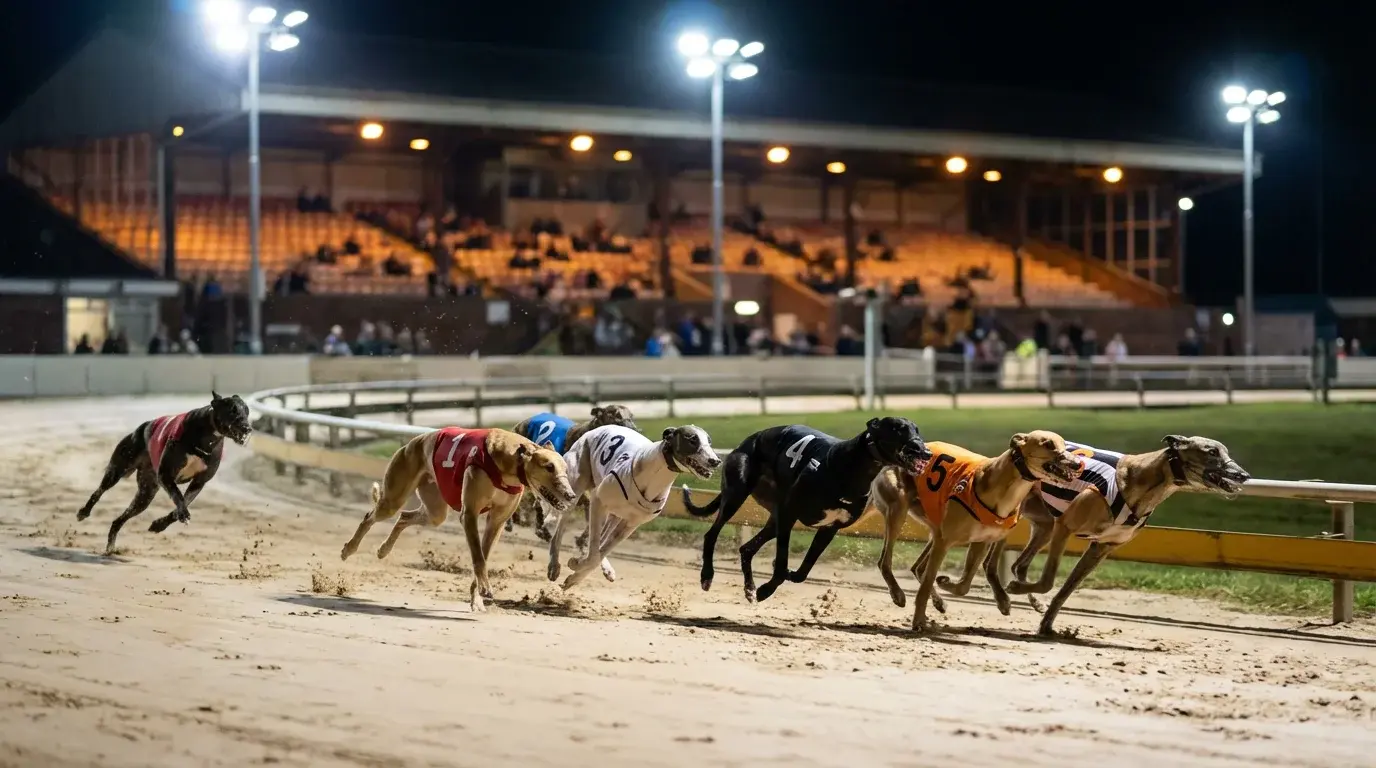
A dog that dominates at Monmore could struggle at Towcester — and the difference is measurable. UK greyhound racing takes place across 20 GBGB-licensed stadiums (though closures in 2025 have reduced that number), and while the basic format is always the same (six dogs, mechanical traps, sand surface), the racing conditions at each venue are anything but uniform. Circumference, bend geometry, surface composition, hare system, run-up distance, and local weather patterns all vary from track to track, and each variable influences race outcomes in ways that casual punters routinely ignore.
This matters because most form data — times, sectional splits, finishing positions — is track-specific. A 29.30 at Nottingham over 500m is not the same performance as a 29.30 at Romford over 400m. The distances are different, the bends are shaped differently, the run to the first turn is longer or shorter, and the sand may drain faster or slower after rain. Punters who treat all tracks as interchangeable are building predictions on faulty foundations.
The opportunity for those who pay attention is significant. Track knowledge is one of the few genuine informational edges available to a non-professional bettor. You don’t need inside information or proprietary software. You need to understand how a specific track’s geometry favours certain running styles, which traps carry a statistical advantage at that venue, and how local going conditions shift the competitive balance. That’s what this guide provides — a track-by-track breakdown of the characteristics, trap statistics, and betting angles that define UK greyhound racing at venue level.
Whether you specialise in one track or bet across several, the data here will sharpen your predictions. Because the dog is only half the equation. The other half is the track it’s running on.
What Defines a Greyhound Track
Every track is a system with its own physics — circumference, surface, and bend geometry create unique race dynamics. Understanding these variables is the foundation of track-specific analysis, and skipping it means you’re guessing where you should be calculating.
Circumference. UK greyhound tracks range from roughly 380m to over 500m around the circuit. Sunderland, at 379m, is one of the tightest. Hove, with its galloping 455m circumference and 515m standard trip, is one of the most spacious. Circumference determines how sharp the bends are: a smaller track means tighter turns, which favour inside runners and dogs with early pace. Larger tracks allow wider runners and closers more room to operate, because the bends are more sweeping and the straights are longer.
Distances offered. Most tracks offer races across three or four distance categories. Sprint races (roughly 210m–285m) are short, intense, and heavily influenced by trap draw because there’s almost no time to recover from a poor start. Standard middle-distance races (400m–500m, the bread and butter of UK graded racing) balance pace and stamina. Stayer races (600m–700m+) and the occasional marathon (800m+) test endurance and give closers more time to get into the race. The distances available at a track shape its grading calendar and the type of dogs that thrive there.
Surface. Sand is the universal surface for UK greyhound racing, but not all sand is identical. Composition varies — some tracks use finer sand that drains quickly, producing faster going after rain. Others retain moisture longer, meaning slow going persists well after showers have stopped. A few tracks historically used a sand-clay mixture that produces a harder, faster surface in dry conditions. Knowing how a track’s surface responds to weather gives you an edge on race nights following rainfall, when going conditions shift from their default.
Hare system. UK tracks use one of several mechanical hare systems — the Swaffham, Sumner, and McGhee being the most common. Each system runs the hare at slightly different distances from the dogs and at different speeds. While this might seem like a technical footnote, hare positioning affects early pace: a hare that sits further ahead encourages front-runners, while one that’s closer can create bunching at the first bend. The differences are subtle but real, and they contribute to the characteristic race profiles at each venue.
Bend geometry and run-up distance. The run-up — the straight between the traps and the first bend — is a critical variable. A long run-up gives dogs more time to find their stride and sort out positions before the first turn, reducing the impact of trap draw. A short run-up means dogs hit the bend quickly, amplifying the importance of early pace and inside position. Bend tightness works in tandem with this: tight bends at the end of a short run-up create chaos and crowding, while sweeping bends after a long run-up produce more orderly racing.
Trap Statistics Across UK Tracks
Trap 1 doesn’t always win the most — but when it does at a specific track, the edge is real. Trap statistics measure the win percentage and place percentage for each of the six traps at a given venue, usually broken down by distance. They’re the most accessible form of track-specific data, and they reveal biases that many punters either don’t know about or don’t bother to check.
Across UK greyhound racing as a whole, trap 1 tends to produce a slightly higher win rate than trap 6. The general pattern, aggregated across all tracks and distances, shows trap 1 winning somewhere around 18–19% of races, with a gentle decline through to trap 6 at roughly 14–15%. That’s a meaningful spread in a six-runner field where a perfectly even distribution would be 16.7% per trap. But these national averages mask enormous variation between venues.
At tracks with tight bends and short run-ups, the inside trap advantage is amplified. Dogs breaking from traps 1 and 2 reach the first bend on the rail with minimal interference, while dogs from traps 5 and 6 face a wider path and a higher probability of being squeezed. At tracks with more sweeping geometry, the bias flattens out or even reverses — some venues produce a near-equal distribution across all traps, and a handful show a slight advantage for wider traps over certain distances.
The data is freely available from several sources. Greyhound Stats UK publishes regularly updated trap statistics for every GBGB track, broken down by distance and filterable by time period. The Racing Post and Timeform also include trap bias indicators in their form guides. The key is not just to know the overall win percentage for each trap but to check it at the specific distance you’re analysing. A track might show a strong trap 1 bias over 480m but a neutral or reversed bias over 680m, because the longer race gives dogs more time to overcome a poor draw.
When using trap stats in prediction, treat them as context rather than a selection method. A 3% advantage for trap 1 at a specific track means that, all else being equal, the dog in trap 1 has a slightly better chance. But all else is rarely equal — form, class, running style, and going conditions matter more than any trap bias in isolation. The power of trap statistics lies in their ability to tilt your assessment at the margins: when two dogs are closely matched on form, the one drawn in the statistically stronger trap has the edge.
Trap Bias in Sprint Races vs Middle-Distance
Sprint races amplify trap advantage because there’s almost no time to recover from a poor start. Over 225m or 285m, a dog that reaches the first bend in front has less track remaining for a chasing dog to close the gap. The race is often decided by the break from the traps and the first corner, which means trap draw carries disproportionate weight in sprint handicapping. At most UK tracks, inside traps show their strongest win percentages in sprint races, sometimes by margins of 5% or more over outside traps.
Middle-distance races — the standard 450m–500m four-bend trip — distribute the advantage more evenly. There’s enough track for closers to recover from a poor first bend, and the additional bends create more opportunities for positional changes. A dog drawn in trap 6 over 480m has a realistic chance of getting into the race by the second bend, especially at tracks with long straights. The trap bias still exists at most venues, but it’s muted compared to sprints.
Stayer races dilute the draw further. Over 640m or longer, the field tends to sort itself by the halfway point regardless of starting position, and stamina becomes the dominant factor. Trap statistics over these distances often show a near-flat distribution, and some tracks even show outside traps performing marginally better because wide runners have more room to find their rhythm on the sweeping turns. The practical takeaway: weight trap stats heavily in sprint analysis, moderately in middle-distance, and lightly in staying races.
Major UK Tracks — Key Stats and Betting Angles
Know the track before you know the dog. The following profiles cover the most prominent GBGB-licensed venues — the tracks that host the biggest meetings, attract the deepest betting markets, and produce the most form data for punters to work with. Each profile summarises the physical characteristics and the betting angles that matter most.
Towcester. Home of the English Greyhound Derby and the flagship track for UK racing since inheriting the event from Wimbledon. Towcester offers distances from the 270m sprint to the 906m marathon, with the standard trip at 500m. The track is a galloping layout with sweeping bends, which means front-runners don’t dominate as heavily here as at sharper venues. Closers and wide runners fare relatively well, and the trap bias over the main trip is less pronounced than at many smaller circuits. Towcester’s open-race calendar is the fullest in the country, so the quality of dog racing here is consistently high — which compresses the margins and makes value harder to find but more rewarding when you do.
Monmore Green. Located in Wolverhampton, Monmore is one of the busiest tracks in the UK and a strong betting medium. Sprint distances start at 210m, with the standard trip at 480m and stayer races extending to 684m. The track has a moderate circumference and bends that reward dogs with a clean early break. Trap 1 historically performs well over the standard distance, making it a venue where inside draws carry genuine weight. Monmore also hosts the prestigious Ladbrokes Winter Derby — one of the key early-season events.
Brighton and Hove. Hove is one of the largest circuits in the country, and its galloping nature produces a different type of race to sharper venues. The standard four-bend trip is 515m — longer than most — and the track has a long home straight that produces a notably low proportion of all-the-way winners, around 21%. This makes Hove a strong track for closers and dogs with stamina. Trap biases are relatively mild, and races tend to be more competitive through the field. If you follow front-runners exclusively, Hove will frustrate you.
Romford. One of London’s two surviving tracks and a popular venue for evening racing. Romford’s circumference is 350m — among the tighter circuits — and it races over 225m, 400m, 575m, 750m, and 925m. The short circumference and tight bends amplify the trap 1 advantage, particularly over the standard 400m trip. Early-pace dogs from inside traps have a structural edge here. Romford hosts several Category One events including the Essex Vase and the Golden Sprint, and its proximity to London ensures deep weekend markets.
Nottingham. A well-regarded venue with a standard trip of 500m and sprint races at 305m. Nottingham has a moderate-to-large circumference with a fair first bend, making it a reasonably balanced track in terms of trap bias. Form tends to be reliable here — it’s a track where the class dog usually wins, which makes graded racing straightforward to assess but open racing more challenging. The British Breeders Stakes is among the notable events held here.
Sheffield (Owlerton). Racing has been held at Owlerton since 1932, making it one of the oldest active venues in the country. The stadium itself opened in 1929 for speedway, with greyhound racing starting on 12 January 1932. The standard trip is 500m, with races also offered over 280m and 660m. Sheffield’s layout features a long run-up to the first bend, which reduces the severity of trap bias over the main distance — dogs from wider traps have more time to find position before the first turn. The Queen Mother Memorial Cup is the venue’s flagship event.
Sunderland. The smallest circumference among the major venues at 379m, Sunderland is a tight, sharp track where early pace and inside position matter more than at most other circuits. Standard racing is over 450m, with 640m for stayers. The tight first bend at Sunderland creates bunching, and the proportion of all-the-way winners is relatively low at around 24% despite the small circumference — the tricky bend actually disrupts leaders. This makes it a track where mid-race runners and dogs with tactical speed can outperform their form figures from more galloping venues.
Perry Barr. Birmingham’s primary track has a circumference of 434m with a standard trip of 480m and options ranging from 275m sprint to 895m marathon. The 80m run to the first bend on four-bend races gives dogs a fair chance to settle, and trap biases are moderate. Perry Barr hosts the Laurels and the St Leger, two events with long histories in greyhound racing. The mix of sprint, middle-distance, and staying races makes it a versatile venue, and the grading is competitive enough that class drops here tend to be reliable signals. Note: Perry Barr closed on 23 August 2025, with the greyhound racing operation relocating to Dunstall Park Greyhound Stadium in Wolverhampton.
Newcastle. Located in the northeast, Newcastle races over 480m standard with sprints at 285m and stayers at 640m. The track is known for producing competitive racing with a reasonable balance across traps. Newcastle’s Angel of the North event and the British Bred Maiden Derby attract quality fields. The venue runs a mix of morning, afternoon, and evening meetings, making it one of the more frequently active tracks for BAGS racing — which means plenty of data but thinner markets at off-peak times.
Central Park (Sittingbourne). The Kent venue races over 380m, 491m, 553m, and 731m. Central Park benefited significantly when Wimbledon closed in 2017, inheriting some of the displaced talent pool. The track hosts the Kent Plate and Grand National among its open-race programme. Its moderate circumference and straightforward geometry make it accessible for form analysis, though the quality of fields can vary more than at the most established venues.
Other GBGB-Registered Venues at a Glance
Every track has a quirk — here’s a snapshot of the rest. These venues may receive less headline attention than the major circuits, but each offers distinct characteristics that informed punters can exploit.
Kinsley. A smaller venue in West Yorkshire that runs predominantly BAGS racing. The compact layout favours early-pace dogs, and the meeting schedule is frequent enough to build a solid database of form. Kinsley is one of those tracks where specialists thrive, because the betting public pays less attention to it than to the bigger venues, creating potential value.
Harlow. An Essex track with a tight circumference that amplifies trap bias. Harlow produces a high proportion of front-running winners and suits railers drawn in low traps. The quality of fields is modest compared to nearby Romford, but the grading is competitive and the form tends to be consistent.
Yarmouth. One of the most distinctive tracks in the country. Despite its relatively small circumference of 382m, Yarmouth has a long home straight that produces the fewest all-the-way winners of any UK track — around 20%. Leaders get caught late with surprising regularity here. If you’re looking for a closers’ track, this is it.
Crayford. A south London venue formerly owned by Entain that raced over a variety of distances up to 1048m — the longest standard race in English greyhound racing. The Ladbrokes Springbok hurdles and Champion Hurdle added variety. Crayford’s geometry was moderate, and trap biases were less pronounced than at nearby Romford. Note: Crayford closed permanently on 19 January 2025, with Entain citing declining attendance and insufficient trainer participation.
Doncaster. A Yorkshire track with a solid BAGS racing schedule. Doncaster offers a balanced layout and competitive grading. The track has invested in welfare initiatives and is known for rehoming schemes. From a betting perspective, the racing is honest and form-readable.
Oxford. Reopened under new management, Oxford races over 450m standard with a 650m stayer trip. The venue hosts the bet365 Hunt Cup and Puppy Cup events. Oxford’s moderate circumference and fair first bend make it a track where form translates well from similar-sized venues.
Pelaw Grange. Located in Chester-le-Street, this northeast track runs a regular card of BAGS meetings. The smaller circuit rewards inside speed, and the markets are typically thin — which can mean less efficient pricing and occasional value for punters who know the local dogs.
Mildenhall. A Suffolk venue that joined the GBGB roster more recently. Mildenhall offers a smaller track with limited distances but regular meetings. Data is still building for this venue, which creates an opportunity for early adopters willing to study the emerging patterns.
How to Use Track Data in Your Predictions
Data without application is trivia. Here’s how to turn track numbers into betting decisions. The track profiles and trap statistics above are useful only to the extent that you integrate them into your prediction process — and that means layering track data on top of form analysis, not replacing form analysis with track data.
The first step is matching running style to track geometry. If you’ve identified a dog as a confirmed railer with strong early pace, check whether tonight’s track rewards that profile. A railer at Romford — tight bends, short circumference, strong trap 1 bias — is in its element. The same railer at Hove — sweeping bends, long straights, weak front-runner record — faces a structural disadvantage. This cross-referencing takes seconds and immediately sharpens your assessment.
Second, overlay trap statistics onto the draw. You’ve studied the form and narrowed the race to two contenders. One is drawn in trap 2, the other in trap 5. Check the trap stats for this track at this distance. If trap 2 wins 20% of races and trap 5 wins 13%, that 7-percentage-point difference is a meaningful tiebreaker. It doesn’t guarantee the outcome, but it shifts the probability in one direction — and in betting, consistent small edges compound.
Third, factor in going conditions at the specific venue. Some tracks drain rapidly after rain — their sand composition sheds water quickly, and going returns to standard within hours. Others hold moisture, meaning slow going can persist through an entire evening card even if the rain stopped at midday. If you know that a particular track drains well, a rain forecast becomes less of a form-disrupting factor. If you know it holds moisture, you can adjust times accordingly and look for dogs whose form improves on slower surfaces.
Finally, consider how dogs transfer between tracks. A dog moving from a tight track like Harlow to a galloping circuit like Hove is making a significant transition. Its times won’t transfer directly, and its running style may not suit the new geometry. Dogs that consistently race at one venue are more predictable than those being tried at a new track for the first time. When you see a dog appearing at an unfamiliar track, treat its previous form with an extra degree of caution — it might reproduce it, but it might not, and the market often fails to account for that uncertainty.
The Track You Know Best Is the One That Pays
The profitable punter isn’t the one who can recite stats for every stadium — it’s the one who lives and breathes a single track. Everything in this guide points toward the same conclusion: track knowledge is deep, specific, and cumulative. The more meetings you study at one venue, the more patterns you’ll recognise — which trainers peak at which times of year, how the surface changes through the seasons, which grading secretary tends to drop dogs aggressively after one bad run.
Pick a track. Ideally, one that races frequently and broadcasts its meetings so you can watch replays. Study the cards for every meeting over four to six weeks. Log your selections, check the results, and note where the track’s quirks surprised you. After a month, you’ll understand that venue better than most people in the betting queue — and that understanding translates directly into sharper predictions and better-timed bets.
The data in this guide gives you a starting point for any track in the country. But the real edge comes when you take that starting point and build on it, night after night, at the venue you’ve chosen to know better than anyone else. Track knowledge doesn’t expire and it doesn’t get priced in by the market — because most of the market hasn’t done the work.