Best Greyhound Betting Sites – Bet on Greyhounds in 2026
Loading...
Odds Tell You What the Market Thinks — Not What Will Happen
Odds are someone else’s estimate of probability — and estimates can be wrong. This is the single most important concept in profitable greyhound betting, and the one that most punters never internalise. When a bookmaker prices a dog at 3/1, they’re not telling you it will finish fourth. They’re expressing a market view — shaped by form data, money coming in, and a built-in profit margin — that this dog has roughly a 25% chance of winning. If your analysis tells you the real chance is closer to 35%, the market has mispriced the dog, and that discrepancy is where money is made.
This guide is about understanding that process: how odds are set, what they really represent, and how to identify the gaps between the market’s assessment and your own. We won’t be picking winners in the conventional sense. Instead, we’ll be talking about the concept of value — finding bets where the price on offer exceeds the true probability of the outcome. Value betting is the engine behind every consistently profitable gambler, from exchange professionals to sharp punters at the track.
It requires a shift in thinking. The question after a losing bet isn’t “why did I lose?” but “was the price right?” And the question after a winning bet isn’t “how much did I make?” but “would I take that price again?” If you can learn to evaluate your bets through the lens of price rather than outcome, you’ll approach greyhound betting with a clarity that most of the market lacks.
Let’s start with what the numbers are actually saying.
Understanding Greyhound Odds Formats
Before you can find value, you need fluency in the language of odds. UK greyhound racing uses three formats, and being comfortable converting between them — plus understanding the implied probability behind each — is a prerequisite for serious betting.
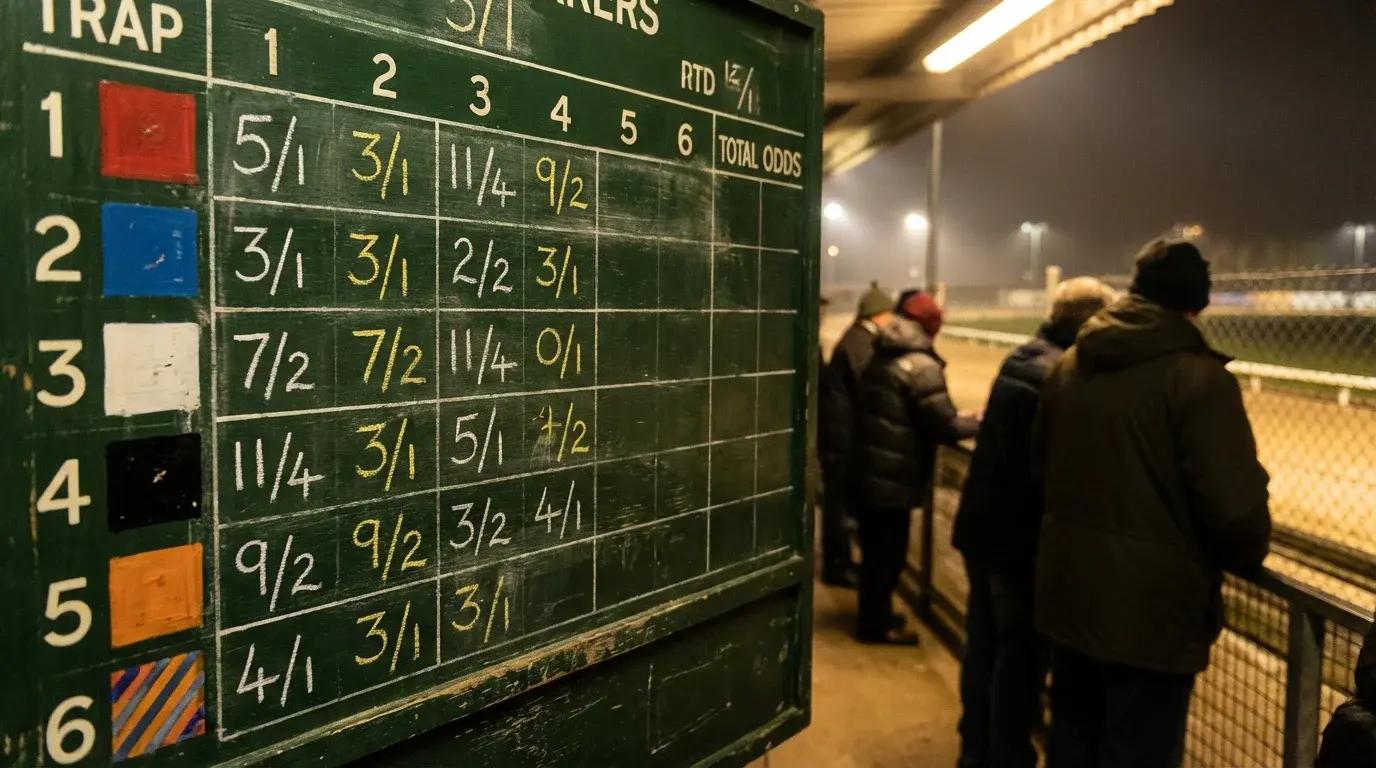
Fractional odds are the traditional UK format and the one you’ll see at the track, in betting shops, and on most British bookmaker sites. Written as 5/1 (spoken as “five to one”), the fraction tells you the profit relative to your stake. At 5/1, a £10 bet returns £60 — £50 profit plus your £10 stake. At 2/1, a £10 bet returns £30. At 1/2, a £10 bet returns £15 — shorter odds mean you’re laying out more to win less, because the market considers the outcome more likely.
Decimal odds are standard on betting exchanges and increasingly common on online bookmakers. They represent the total return per unit staked, including the stake. Decimal 6.0 is the same as fractional 5/1: a £10 bet returns £60 total. Decimal 3.0 equals 2/1. Decimal 1.5 equals 1/2. The conversion formula is straightforward: decimal = (fractional numerator / denominator) + 1. Decimal odds are mathematically cleaner and make implied probability calculations simpler, which is why exchange punters prefer them.
Implied probability is what converts odds into a percentage chance. For fractional odds: implied probability = denominator / (numerator + denominator). At 3/1, the implied probability is 1 / (3 + 1) = 25%. For decimal odds, it’s even simpler: 1 / decimal odds. At 4.0, the implied probability is 1 / 4 = 25%. Understanding implied probability is essential because it lets you compare the market’s assessment with your own. If you believe a dog has a 30% chance and the market implies 25%, you’ve found a value discrepancy.
A useful reference: Evens (1/1, or decimal 2.0) implies a 50% chance. 2/1 (decimal 3.0) implies 33%. 4/1 (decimal 5.0) implies 20%. 9/1 (decimal 10.0) implies 10%. Knowing these conversions instinctively lets you assess prices in real time without reaching for a calculator.
How Bookmakers Set Greyhound Odds
Every set of odds includes a tax — the bookmaker’s margin. Your job is to find the prices where the margin doesn’t account for reality. Understanding how odds are constructed reveals why certain prices offer value and others don’t.
Bookmakers begin with a tissue price — an internal assessment of each dog’s probability, produced by their trading team using form data, time analysis, and market intelligence. These probabilities are then converted into odds with a margin added. In a perfectly fair market, the implied probabilities of all six runners would sum to 100%. In practice, they sum to somewhere between 115% and 125% — the excess is the bookmaker’s overround, and it’s how they guarantee a profit regardless of the outcome.
A simple example: if a bookmaker assesses six dogs as having equal 16.7% chances, fair odds would be 5/1 on each. Instead, they might offer 4/1 on each, implying a 20% chance per dog — and 6 x 20% = 120%. That 20% overround is the bookmaker’s built-in advantage. The overround is not distributed evenly. Favourites tend to have smaller margins applied (the bookmaker is more confident in their assessment of likely winners), while outsiders carry a disproportionate share of the overround. This is known as the “favourite-longshot bias” — outsiders are systematically overpriced relative to their true probability.
After the initial tissue, prices adjust based on market action. If money floods in on one dog, the bookmaker shortens its price and drifts the others to maintain the margin. This is why early prices and starting prices (SP) can differ significantly. Taking an early price locks in a return that may not be available later — or may turn out to be worse than the SP if the dog drifts.
Best-odds-guaranteed (BOG) is a promotional feature offered by most major bookmakers on greyhound racing. If you take an early price and the SP is higher, you’re paid at the better price. BOG effectively eliminates the downside of taking early prices and should be used whenever available — it’s free insurance against your timing being wrong. If a bookmaker doesn’t offer BOG on greyhounds, factor that into your decision about when to bet.
What Is a Value Bet in Greyhound Racing
Value is a mathematical concept, not a feeling. It exists when your assessment of probability exceeds the market’s. If you believe a dog has a 30% chance of winning and the bookmaker’s odds imply a 20% chance, the bet has positive expected value. Over a large sample of such bets, you’ll make money — not because every bet wins, but because the ones that do win pay more than the frequency of losing would cost.
This is the core principle behind all professional gambling, and it applies to greyhound racing as much as any other market. The challenge is that estimating true probabilities is hard. Unlike a coin flip, where the probability is known and fixed, a greyhound race involves six live animals, mechanical variables, and human factors that resist precise quantification. Nobody can tell you with certainty that a dog has a 32.7% chance of winning. But you can make informed estimates — and if those estimates are consistently closer to reality than the bookmaker’s, you have an edge.
Consider two scenarios. In the first, you’ve identified a dog at 4/1 (implied probability 20%) that you believe has a genuine 30% chance. Your analysis is based on strong recent form, a favourable trap draw, and going conditions that suit the dog’s running style. The market hasn’t fully accounted for one or more of these factors. This is a value bet. In the second scenario, a dog is available at 10/1 (implied probability 9%) and you believe its chance is about 8%. The price looks generous because 10/1 sounds like a big return, but your own assessment says the market is actually right, or even slightly generous. This is not a value bet — the apparent generosity is an illusion.
The distinction is crucial. Value isn’t about backing big-priced dogs for the thrill of a large payout. It’s about backing dogs whose price underestimates their true chance, regardless of whether that price is 2/1 or 20/1. A 2/1 shot that you assess as a 40% chance is a value bet. A 10/1 shot that you assess as a 7% chance is not, even though the potential return is far higher.
Building this discipline takes time. You’ll back value bets that lose — frequently — and it’s tempting to second-guess the approach. But the maths is unambiguous: if you consistently bet at prices that exceed the true probability, you will profit over a large enough sample. The question is whether you have the patience and the conviction to let the sample grow large enough.
How to Calculate Expected Value on a Greyhound Bet
Expected value (EV) is the formula that puts a number on the value concept. The calculation is: EV = (Probability of winning x Net profit if win) – (Probability of losing x Stake). A positive EV means the bet is profitable in the long run; a negative EV means it’s not.
Walk through an example. You assess a dog’s chance of winning at 30% (0.30). The odds are 4/1, meaning a £10 bet returns £40 profit if it wins. The EV calculation: (0.30 x £40) – (0.70 x £10) = £12 – £7 = +£5. The expected value is positive £5 per bet at this price. Over 100 identical bets, you’d expect to win roughly 30 times (collecting £40 profit each time = £1,200) and lose roughly 70 times (losing £10 each time = £700). Net profit: £500, or £5 per bet on average — exactly what the EV calculation predicted.
Now change the odds. Same 30% dog, but the price is 2/1 instead of 4/1. EV = (0.30 x £20) – (0.70 x £10) = £6 – £7 = –£1. The expected value is negative. Even though the dog wins 30% of the time, the price doesn’t compensate for the 70% of the time it loses. This is a bad bet at this price, regardless of whether the dog wins tonight.
The practical difficulty is that you’re estimating the probability, not measuring it. Your 30% assessment could be off — maybe the true probability is 25% or 35%. This is why volume matters. Over a small sample, estimation errors can dominate. Over hundreds of bets, if your method of estimating probabilities is sound, the errors tend to average out and the positive EV bets deliver their expected profit.
Using Odds Comparison Tools to Maximise Returns
The laziest edge in greyhound betting is also the most reliable: take the best price. Odds comparison is the simplest value-boosting habit available, and it requires no analytical skill at all — just the discipline to check multiple bookmakers before placing a bet.
The principle is straightforward. Different bookmakers offer different odds on the same dog in the same race. One might price a dog at 7/2, another at 4/1, and a third at 9/2. If you’ve decided to back this dog, taking 9/2 instead of 7/2 increases your return by nearly 30% for the same stake on the same outcome. Over a year of regular betting, consistently taking the best available price adds 10–20% to total returns compared to sticking with a single bookmaker. That margin can be the difference between a losing year and a profitable one.
Odds comparison sites aggregate prices from dozens of bookmakers in real time and display them side by side. For greyhound racing specifically, the coverage is less comprehensive than for horse racing — not every bookmaker prices every BAGS meeting — but the major operators are well represented. A glance at the comparison table before each bet takes 15 seconds and costs nothing.
The multi-account strategy follows naturally. To access the best price consistently, you need accounts with several bookmakers. Five to eight accounts across the major operators covers most of the market. The administrative burden is minimal once the accounts are set up, and the return on that effort is immediate and ongoing. Some punters resist this, preferring the convenience of a single account, but the price difference is real money left on the table.
One practical note: some bookmakers restrict or close accounts that consistently take only the best prices, particularly on greyhounds where margins are thinner than on horse racing. Maintaining normal betting activity across accounts — not just cherry-picking the best odds — helps avoid restrictions. But even if one or two accounts are limited, the overall strategy remains profitable as long as you have enough open accounts to access competitive prices.
Exchange Odds vs Bookmaker Odds: When Each Wins
Exchanges and bookmakers serve different masters — and the smart punter uses both. The Betfair exchange and traditional bookmakers price greyhound races using different mechanisms, and each offers an advantage in specific situations. Knowing when to use which platform adds another percentage point or two to your long-term returns.
Exchange odds are set by the market — by other punters willing to back or lay a dog. Because there’s no bookmaker margin, the raw odds on an exchange are almost always better than the equivalent bookmaker price. A dog priced at 3/1 with a bookmaker might be available at 3.5 (5/2) or higher on the exchange. The catch is commission: Betfair charges a percentage of your net winnings on each market, typically starting at 5% for new accounts and reducing with volume. Even after commission, the net return often exceeds what you’d get from a bookmaker — particularly at shorter prices where the bookmaker’s margin is most visible.
Bookmaker odds have their own advantage: best-odds-guaranteed. BOG is essentially a free option — you take an early price, and if the SP is higher, you’re upgraded. Exchanges don’t offer this. If you back at 3.5 on Betfair and the price moves to 5.0 before the off, you’re stuck at 3.5. With a BOG bookmaker, you’d be paid at the better price. In races where a dog’s price is likely to drift — because the market hasn’t yet adjusted to a form concern or a trainer move — the BOG bookmaker can deliver a better effective price than the exchange.
The practical approach is to compare both platforms for every bet. If the exchange price after commission exceeds the best bookmaker price (even with BOG), use the exchange. If the bookmaker price with BOG is competitive and you expect the price to drift, use the bookmaker. At shorter odds (under 3/1), the exchange usually wins because bookmaker margins are widest on favourites. At longer odds (over 5/1), bookmakers often match or beat exchange prices once commission is factored in, and BOG provides additional upside. The few seconds it takes to compare is time well spent.
Reading Market Movements for Greyhound Races
When the price moves, someone knows something — or thinks they do. Market movements in greyhound racing carry information, and learning to read them adds a supplementary data layer to your form analysis. The key is treating market signals as supporting evidence, not primary evidence.
A steam move occurs when a dog’s price shortens significantly across multiple bookmakers in a short period, typically in the 15 to 30 minutes before the race. A shift from 5/1 to 3/1 across four or five bookmakers simultaneously is a steam move — it usually reflects informed money entering the market. The source might be a trainer connection who knows the dog trialled well, a sharp punter who has identified a form angle the market missed, or a professional who has modelled the race and found an inefficiency.
A drifter is the opposite: a dog whose price lengthens notably before the off. A drift from 2/1 to 7/2 suggests money is moving away, which can indicate inside knowledge of a problem — a dog that looked poor in the parade, a late change in going conditions that doesn’t suit the selection, or simply a reassessment by the market that the price was too short. Drifters are not always losers, but backing them consistently is a losing strategy over large samples.
The subtlety lies in the context. Greyhound markets are thin compared to horse racing, which means relatively small amounts of money can cause significant price shifts. A single confident punter placing £500 on a dog at a BAGS meeting can move the market from 4/1 to 5/2 without any meaningful new information being in play. This is why steam moves are more reliable at evening and Saturday meetings, where the market is deeper and it takes more money — and therefore more conviction — to shift prices.
The most useful application of market movement data is as a confirmation tool. If your form analysis points to a dog and the market then shortens its price, you have two independent signals pointing in the same direction. If your analysis points one way but the market is moving the other way, that’s a reason to pause and recheck. The market isn’t always right, but when it disagrees with you, it’s worth understanding why before committing your money.
The Price Is Right — If You Think in Hundreds of Bets
The question after every bet isn’t “did I win?” — it’s “would I make that bet again at the same price?” This reframe is the hardest mental shift in value betting, and it’s also the most important. Outcomes in individual races are largely irrelevant to your long-term profitability. What matters is whether the process that generated your bets is sound — whether you’re consistently finding prices that exceed the true probability.
Short-term variance in greyhound betting is brutal. You can back ten consecutive value bets and lose eight of them. That’s not failure; it’s statistics. A dog with a 30% chance of winning loses 70% of the time. String a few 70% outcomes together — which is entirely ordinary — and it looks like your method is broken. It’s not. It just hasn’t had enough bets for the maths to show through.
The benchmark for evaluating your approach is 500 bets or more. Below that, variance dominates and results are unreliable as a measure of method quality. At 500 bets, the signal starts to emerge. At 1,000, it’s much clearer. If your ROI is positive over 1,000 bets of tracked, value-driven selections, you have a genuine edge. If it’s negative, your probability estimates need recalibrating — not your approach to value betting itself.
Tracking every bet is therefore non-negotiable. Without records, you can’t calculate ROI, you can’t identify which race types or tracks produce your best results, and you can’t distinguish between bad luck and bad judgement. Log every selection: date, track, dog, odds, stake, result. Review monthly. Adjust quarterly. The discipline of record-keeping is the mechanism that turns a theoretical understanding of value into practical, measurable profit.
Greyhound racing will always involve uncertainty — that’s what makes it a betting sport. But the price on offer doesn’t have to be uncertain. Find the mispriced dog, take the value, and trust the maths. The market will be wrong often enough to pay you, as long as you’re patient enough to collect.